Justa Pasta's Cheesecake
as printed in the Oregonian in September 2004 (thanks to Sara Perry for sending it to me after I struggled accessing the archives!)
Makes one 10-inch cake, serving 14 to 16 (or more; 21 1.5" slices have 386 calories each)
Crumb Crust
3 cups graham cracker crumbs (19-20 whole cracker sheets)
1/2 cup firmly packed light brown sugar
1/2 cup unsalted butter, softened
Filling
Four 8-ounce packages (32 ounces total) cream cheese, at room temperature
1 cup granulated sugar, preferably baker’s
1 teaspoon vanilla extract
1/2 teaspoon almond extract
1 egg, at room temperature
Topping
2 cups sour cream
3/4 cup granulated sugar
Juice from 1 medium lemon
1/2 teaspoon vanilla extract
Drop of almond extract
Do not preheat the oven.
To make the crumb crust: Mix together the graham cracker crumbs, sugar, and butter until well blended and crumbly (my Cuisinart had the softening cream cheese in it, so I put the crushed-slightly-with-my-fingertips crackers in my Kitchenaid with the butter and brown sugar, and it worked just great to break them down further). Transfer to a 10-inch springform pan and firmly press the mixture onto the bottom of the pan (I use my straight-sided metal one-cup measure). Chill the crust while making the filling.
To make the filling: In a food processor, combine the cream cheese, sugar, vanilla and almond extract until creamy and smooth, scraping down the sides and bottom of the bowl as necessary. Beat in the egg until fully blended. Pour into the springform pan and place it in the center of the cold oven. Turn on the oven to 350 degrees and bake for 40 minutes.
To make the topping: Meanwhile, mix together the sour cream, sugar, lemon juice, vanilla and almond extract until blended. Remove the cheesecake from the oven and gently (very! one time I made this I wasn't so gentle, and made a big divot in the filling from the topping waterfall) spread the topping over the cake. Lower the oven to 300 degrees and bake for 15 additional minutes. Transfer to the refrigerator to chill at least 4 hours or overnight. Using a paring knife, loosen the sides from the inside edge of the pan. Slice and serve.
Showing posts with label hostess with the mostes'?. Show all posts
Showing posts with label hostess with the mostes'?. Show all posts
Saturday, January 14, 2012
Justa Pasta Cheesecake
I should, but do not, have a picture of this. I have made it several times and each time am flabbergasted by how good it is. It is not like other cheesecakes (flash of Michael Jackson saying, "I'm not like other guys" in the Thriller video), and no one ever leaves any on his or her plate, no matter how much they might not usually like cheesecake. The one change I might possibly suggest would be to use the juice of half a lemon instead of a whole.

Tuesday, December 7, 2010
Smørbrød, or, Something to Eat When You're Tired of Turkey
I hosted a dinner party on Thanksgiving weekend and wanted it to resemble turkey and trimmings as little as possible. So, a Scandinavian theme! We started the evening with gjetost on Kavli with butter and honey, and then four different smørbrød. Smørbrød (this is the Norwegian spelling; the Danes say smörrebröd) literally means "buttered bread," but has come to mean small, fancy open-faced sandwiches. Web research and cookbooks told me a smørbrød layout usually starts with fish and eggs, proceeds with liver, and then moves on to red meat, so that's what we did.

First up (ingredients in order of assembly): rye bread (I found small loaves of thinly sliced bread at the grocery store, labeled "party slices"), butter, spinach, cucumber, scrambled eggs, herbed chèvre, ivory smoked Chinook salmon, dill. To make perfect scrambled eggs, whisk 8-10 eggs with 2 oz softened cream cheese, salt and pepper until cream cheese is in small bits, then cook in a nonstick skillet over medium heat, stirring constantly, until just set.

Next: sourdough, butter, forgot the spinach, Chop chicken liver pâté with pistachios and brandy-soaked currants, homemade cranberry sauce (thanks to J's mom!), crispy onions.

Aaaaah: pumpernickel, butter, spinach, havarti, thinly-sliced rare-side-of-medium steak (this was the last steak from our 1/16, a cube steak, but I think any steak would work), tomato, plain or pickled thinly sliced red onion, minced flat-leaf parsley.
I made my own pickled red onion: halve onion pole to pole, peel, then slice very thin with a mandoline. Toss sliced onions in a small bowl with a tablespoon of kosher salt, top with a cup or two of ice cubes, then let sit for a couple of hours. Meanwhile, make a sugar-vinegar solution. I think I started out with a cup of sugar and a half-cup of vinegar, and then added another half-cup of vinegar when it seemed too syrupy and not like the refrigerator pickles I remembered my dad making when I was a kid. I think next time I'll try replacing half the vinegar with water, to make them a tad less potent. Anyway, you'll probably need to heat the vinegar some for the sugar to dissolve completely, and a quick zap in the microwave did the trick for me. Once the sugar is completely dissolved, set it aside to cool while the onions sit. After a couple of hours, pick out the ice cubes and drain the onions well, then stir them into the sweet brine. Cover the bowl and refrigerate overnight.

Finally: Trader Joe's European-style whole grain bread, butter, forgot the spinach, jarlsberg, Swedish potato sausage, sour cream, chives. This was the only combo that wasn't spot-on perfect. I think the bread was a bit dense, and the whole thing needed something to moisten and tang it up. Or maybe it just seemed bland after the very exciting steak sandwich that came before it.
Once everyone had polished off the assembled sandwiches, I hauled out all the raw ingredients (there were leftovers of almost everything other than the tomato) and let my guests build their own smørbrød until they couldn't eat any more (I was fine with just the four!):

For dessert? Riskrem, aka Norwegian Christmas Rice Pudding. I can't give you an exact recipe on this, since I didn't measure anything. Essentially, though, you cook arborio rice (maybe 1 1/2 C?) in whole milk (6 C?) with a little salt until the rice is tender and most of the liquid is absorbed (there should still be some, though, as the rice will continue to soak it up as it cools). Then you stir in sugar (1/2-3/4 C) and vanilla (2 t) and let cool. Then you whip a cup or so of cream and fold it in, along with (if you want) the prize almond (I skipped it this time). Serve with jam (I had rhubarb-ginger, tayberry and cloudberry) and cookies (ginger thins + Danish butter cookies).


First up (ingredients in order of assembly): rye bread (I found small loaves of thinly sliced bread at the grocery store, labeled "party slices"), butter, spinach, cucumber, scrambled eggs, herbed chèvre, ivory smoked Chinook salmon, dill. To make perfect scrambled eggs, whisk 8-10 eggs with 2 oz softened cream cheese, salt and pepper until cream cheese is in small bits, then cook in a nonstick skillet over medium heat, stirring constantly, until just set.

Next: sourdough, butter, forgot the spinach, Chop chicken liver pâté with pistachios and brandy-soaked currants, homemade cranberry sauce (thanks to J's mom!), crispy onions.

Aaaaah: pumpernickel, butter, spinach, havarti, thinly-sliced rare-side-of-medium steak (this was the last steak from our 1/16, a cube steak, but I think any steak would work), tomato, plain or pickled thinly sliced red onion, minced flat-leaf parsley.
I made my own pickled red onion: halve onion pole to pole, peel, then slice very thin with a mandoline. Toss sliced onions in a small bowl with a tablespoon of kosher salt, top with a cup or two of ice cubes, then let sit for a couple of hours. Meanwhile, make a sugar-vinegar solution. I think I started out with a cup of sugar and a half-cup of vinegar, and then added another half-cup of vinegar when it seemed too syrupy and not like the refrigerator pickles I remembered my dad making when I was a kid. I think next time I'll try replacing half the vinegar with water, to make them a tad less potent. Anyway, you'll probably need to heat the vinegar some for the sugar to dissolve completely, and a quick zap in the microwave did the trick for me. Once the sugar is completely dissolved, set it aside to cool while the onions sit. After a couple of hours, pick out the ice cubes and drain the onions well, then stir them into the sweet brine. Cover the bowl and refrigerate overnight.

Finally: Trader Joe's European-style whole grain bread, butter, forgot the spinach, jarlsberg, Swedish potato sausage, sour cream, chives. This was the only combo that wasn't spot-on perfect. I think the bread was a bit dense, and the whole thing needed something to moisten and tang it up. Or maybe it just seemed bland after the very exciting steak sandwich that came before it.
Once everyone had polished off the assembled sandwiches, I hauled out all the raw ingredients (there were leftovers of almost everything other than the tomato) and let my guests build their own smørbrød until they couldn't eat any more (I was fine with just the four!):

For dessert? Riskrem, aka Norwegian Christmas Rice Pudding. I can't give you an exact recipe on this, since I didn't measure anything. Essentially, though, you cook arborio rice (maybe 1 1/2 C?) in whole milk (6 C?) with a little salt until the rice is tender and most of the liquid is absorbed (there should still be some, though, as the rice will continue to soak it up as it cools). Then you stir in sugar (1/2-3/4 C) and vanilla (2 t) and let cool. Then you whip a cup or so of cream and fold it in, along with (if you want) the prize almond (I skipped it this time). Serve with jam (I had rhubarb-ginger, tayberry and cloudberry) and cookies (ginger thins + Danish butter cookies).
Copenhagen Butter Cookies
from Sheila Lukins' All Around the World Cookbook
1 C unsalted butter, softened
2/3 C superfine sugar
1 t vanilla
1/2 t salt
2 C flour
Mix butter, sugar, vanilla and salt until thoroughly combined, but not fluffy. Mix in the flour just until it's fully incorporated. Form the dough into a log, wrap tightly in plastic wrap, and refrigerate at least 2 hours or overnight. Either cut dough log into scant-1/4" slices, or let the dough warm up just a little before rolling and cutting. Bake at 350 until the edges are golden brown, 15-20 minutes. Let cool 10 minutes on baking sheet before transferring to a wire rack to cool completely.

Saturday, January 24, 2009
Life Without Corn
Our book group book this time around was The Omnivore's Dilemma by Michael Pollan. Inspired by the first section of the book, I thought I should try to avoid corn by-products in today's menu. It really wasn't all that hard--just avoid processed foods and non-organic meat. It's a good thing no one in attendance had nut allergies, since three different nuts were featured in three dishes today.
Hazelnut-Crusted Wild Alaskan True Cod with Cranberry Jelly
Nutted Wild Rice with Blood Oranges
Roasted Green Beans
Wintertime Chocolate-Caramel Tart
Tillamook Vanilla Bean Ice Cream
The fish was easy. I mixed some ground hazelnuts with about the same amount of bread crumbs, stirred in a little olive oil and salt and pepper, and spread it on the fish.

The green beans were also a cinch. The beans I found were a bit on the less-photogenic side, slightly shriveled and not the slim and lovely ones I love to eat, blanched, in late summer. Cook's Illustrated a couple of years back had talked about roasting as an option for this caliber of bean, and it is genius. Just snap off stem ends and spread on a foil-lined pan (for both the fish and the beans I used the bottom of a broiler pan, since they are less likely than my cookie sheet to warp in the oven), drizzle with a little olive oil and sprinkle with a little salt and pepper, and toss to coat.

Both the fish and the beans were set to cook at 450, so I was able to do them together, putting the fish in when the beans were ready for a stir after 10 minutes. The beans needed another 10 minutes to get spotty brown, and the fish a few minutes longer than that to get firm and just flaky. Delicious. I thought as I was putting it on the table that the fish could use some kind of sauce, so pulled out a jar of homemade cranberry jelly (from local cranberries, of course).
The salad is one I've been wanting to fix for book group for several years, since Grandpa Artsy-Fartsy fixed it on a visit. Perfect for citrus season. I made it pretty much straight, except with fewer raisins, I used blood oranges instead of navels, and I added the segments from about a half-dozen blood oranges (this last addition seemed like kind of a "duh" to me--how could you make a salad with an orange-juice-based dressing and not put any actual oranges in it?).
The dressing:

The segmented oranges (you slice off the peels with a serrated knife, then carefully cut alongside the membranes to release the good stuff):

The last bit (not a great photo, and in any case it tastes better than it looks):

The tart appeared in the paper last month. Nuts, caramel, chocolate, what else do you need? The only change I made was to use chocolate graham crackers instead of chocolate wafers for the crust. I think the wafers would have worked better.
The mixed-together crust:

Pressing the crust mix into the tart pan. I think I read the tip to use a stainless measuring cup in Cook's Illustrated. It really does an amazing job of preventing that blobby thick crust corner you can get if you use your fingers to press it into the pan.

The sugar and water, ready to make into caramel. The recipe says to stir it until the sugar is dissolved, but doesn't say to then stop stirring. But you should, because otherwise . . .

this happens. It ended up okay in the long run, but it would have been better had I not continued to stir.

The cream to stir into the melted sugar:
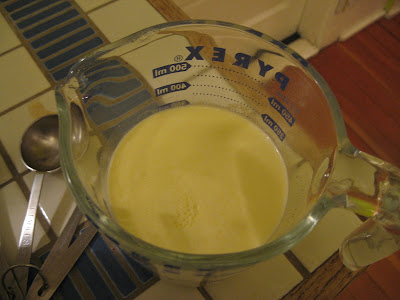
The egg and vanilla to fold into the cool-ish caramel:

The baked almond caramel in the chocolate tart shell:

Now, the recipe calls for heating cream on the stovetop and adding it to chopped chocolate to make the ganache. I always make my ganache in the microwave, with the cream and chocolate in the same bowl. Start out with a minute on high, then stir well, and zap in additional 30-second increments, stirring well in between (I think it did maybe two extra 30-second periods). It will start out looking like this:

Proceed to this:

And finally end up like this, smooth and glossy:

Here's what the cooked tart looked like. I thought it was pretty good, and the other members of the group RAVED. I thought the crust could have been better (I'll use the wafers next time), and the nuts didn't retain their roasted crunch. I don't know if that was because of how I stored it, or just a quirk of the recipe.

Now, I had originally planned to make homemade vanilla ice cream (I finally got around to making the custard today, with the Wizard's help), which would have been corn-free, but the Tillamook did unfortunately feature HFCS among its ingredients. There were also corn products in the graham crackers I used for the tart crust, and possibly in the bread crumbs I put on the fish (they weren't made from home-made bread). I guess technically the eggs probably also came from corn, but you can't really count that because chickens (unlike cows) are made to eat corn.
Hazelnut-Crusted Wild Alaskan True Cod with Cranberry Jelly
Nutted Wild Rice with Blood Oranges
Roasted Green Beans
Wintertime Chocolate-Caramel Tart
Tillamook Vanilla Bean Ice Cream
The fish was easy. I mixed some ground hazelnuts with about the same amount of bread crumbs, stirred in a little olive oil and salt and pepper, and spread it on the fish.

The green beans were also a cinch. The beans I found were a bit on the less-photogenic side, slightly shriveled and not the slim and lovely ones I love to eat, blanched, in late summer. Cook's Illustrated a couple of years back had talked about roasting as an option for this caliber of bean, and it is genius. Just snap off stem ends and spread on a foil-lined pan (for both the fish and the beans I used the bottom of a broiler pan, since they are less likely than my cookie sheet to warp in the oven), drizzle with a little olive oil and sprinkle with a little salt and pepper, and toss to coat.

Both the fish and the beans were set to cook at 450, so I was able to do them together, putting the fish in when the beans were ready for a stir after 10 minutes. The beans needed another 10 minutes to get spotty brown, and the fish a few minutes longer than that to get firm and just flaky. Delicious. I thought as I was putting it on the table that the fish could use some kind of sauce, so pulled out a jar of homemade cranberry jelly (from local cranberries, of course).
The salad is one I've been wanting to fix for book group for several years, since Grandpa Artsy-Fartsy fixed it on a visit. Perfect for citrus season. I made it pretty much straight, except with fewer raisins, I used blood oranges instead of navels, and I added the segments from about a half-dozen blood oranges (this last addition seemed like kind of a "duh" to me--how could you make a salad with an orange-juice-based dressing and not put any actual oranges in it?).
The dressing:

The segmented oranges (you slice off the peels with a serrated knife, then carefully cut alongside the membranes to release the good stuff):

The last bit (not a great photo, and in any case it tastes better than it looks):

The tart appeared in the paper last month. Nuts, caramel, chocolate, what else do you need? The only change I made was to use chocolate graham crackers instead of chocolate wafers for the crust. I think the wafers would have worked better.
The mixed-together crust:

Pressing the crust mix into the tart pan. I think I read the tip to use a stainless measuring cup in Cook's Illustrated. It really does an amazing job of preventing that blobby thick crust corner you can get if you use your fingers to press it into the pan.

The sugar and water, ready to make into caramel. The recipe says to stir it until the sugar is dissolved, but doesn't say to then stop stirring. But you should, because otherwise . . .

this happens. It ended up okay in the long run, but it would have been better had I not continued to stir.

The cream to stir into the melted sugar:

The egg and vanilla to fold into the cool-ish caramel:

The baked almond caramel in the chocolate tart shell:

Now, the recipe calls for heating cream on the stovetop and adding it to chopped chocolate to make the ganache. I always make my ganache in the microwave, with the cream and chocolate in the same bowl. Start out with a minute on high, then stir well, and zap in additional 30-second increments, stirring well in between (I think it did maybe two extra 30-second periods). It will start out looking like this:

Proceed to this:

And finally end up like this, smooth and glossy:

Here's what the cooked tart looked like. I thought it was pretty good, and the other members of the group RAVED. I thought the crust could have been better (I'll use the wafers next time), and the nuts didn't retain their roasted crunch. I don't know if that was because of how I stored it, or just a quirk of the recipe.

Now, I had originally planned to make homemade vanilla ice cream (I finally got around to making the custard today, with the Wizard's help), which would have been corn-free, but the Tillamook did unfortunately feature HFCS among its ingredients. There were also corn products in the graham crackers I used for the tart crust, and possibly in the bread crumbs I put on the fish (they weren't made from home-made bread). I guess technically the eggs probably also came from corn, but you can't really count that because chickens (unlike cows) are made to eat corn.
Monday, November 17, 2008
Goin' All Medieval on Your Tummy
Book group met on Saturday last to discuss The Goose Girl, young adult fiction by Shannon Hale. It's set in a medieval-Europe-type place, and tells the story of an intrepid princess and her (mis-)adventures, which inlcuded serving for a time as a goosekeeper. I thought soup sounded appropriately peasant-y, served with a simple and simply-dressed green salad and crusty bread. We started with the leftover cheese from my brother's birthday party (11 kinds!), and we finished with Panna Cotta with Almond Cream and Pomegranate, so no one was in danger of experiencing butterfat deficiency.

Some of the cheeses.

I decided not to unmold them to save time, and I don't know if they would have stood up on the plate if I had. Certainly by the following day (two days after mixing them up), they were pretty runny, but still edible. I suspect it was because of the live cultures in the yogurt.

Some of the cheeses.

Fettuccine and White Bean Soup
adapted from Cook's Illustrated Sept/Oct 1999
1/4 C olive oil
4 oz prosciutto, diced fine
1 med onion, diced fine
1 14.5-oz can diced tomatoes, with liquid
1 celery stalk, diced fine
1 med potato, peeled and cut into 1/2" dice
2 t salt (unless you are able to find low-sodium everything, I would start with a teaspoon here and add more if needed later)
2 15.5-oz cans white beans, with liquid
1 1/2 T minced fresh sage leaves
5 oz fettuccine, broken into 2" pieces
ground black pepper
Heat olive oil in large dutch oven over medium heat. Add prosciutto and onion; sauté until onion is translucent, 4-5 minutes. Add tomatoes with their liquid, celery, potato, salt, beans with their liquid, sage, and 6 C water; bring to a boil and cook until potato is tender, about 5 minutes. Add fettuccine and cook, stirring occasionally, until pasta is tender, 7-8 minutes. Off heat, adjust seasonings and serve.

Butternut Squash Soup
adapted from Cook's Illustrated, Nov/Dec 2001
4 T unsalted butter
2 med shallots, minced (about 1/4 C)
1 carrot, peeled and diced fine
2 celery rib, diced fine
6 C water, or part homemade chicken stock (I used just water this time and it was great)
3 lb butternut squash, halved lengthwise, seeds and pulp removed and reserved, and each half cut into quarters
salt
1/2 C heavy cream
1 t dark brown sugar
1. Heat butter in large dutch oven over medium-low heat until foaming; add shallots, carrot and celery and cook, stirring frequently, until shallot and celery are softened and translucent, about 3 minutes. Add squash seeds and pulp and cook, stirring occasionally, until fragrant and breaking down, about 4 minutes. Add water or mixed water and stock, and 1 1/2 t salt and bring to boil over high heat; reduce heat to medium-low, and put squash over simmering liquid in steamer basket. Cover and steam until squash is completely tender, about 30 minutes. Off heat, use tongs to transfer squash to shallow dish; reserve cooking liquid. When cool enough to handle, remove peels and strings from squash and transfer flesh to medium bowl; discard skin.
2. Pour reserved steaming liquid through mesh strainer into second bowl; discard solids. Rinse dutch oven if it's yukky.
3. Use your preferred method to purée squash and liquid--either in a blender, with a stick blender in the pot, or by running squash through a food mill. Heat over medium heat until at least simmering; remove from heat and stir in cream and brown sugar. Adjust seasonings and serve.

Panna Cotta with Almond Cream and Pomegranate
published in the Oregonian FOODday, December 13, 2005
from Cathy Whims of Nostrana
(it's still on the menu, currently with blackberry sauce)
Panna cotta:
2 C heavy cream
1 1/2 t unflavored gelatin
1 C sugar
2 C whole-milk plain yogurt (she likes Nancy's; I used Brown Cow)
Almond cream:
1/4 lb almonds (orig recipe calls for whole unblanched; I used diced roasted and loved the flavor)
5 T sugar
2 C heavy cream
tiny pinch of salt
1-2 drops almond extract
1/2 C pomegranate seeds for garnish
To make panna cotta: Pour the cream into a small saucepan and sprinkle the gelatin over the cream. Let stand for 15 minutes. Add the sugar to the cream mixture and heat over medium eat until just hot to the touch. Stir well to be sure the gelatin and sugar are dissolved (it will look a little yellow) and then take off heat. Whisk yogurt in a mixing bowl until smooth. Slowly whisk in hot cream mixture. Pour into 8-12 4-oz ramekins (sprayed with nonstick cooking spray if you're going to want to unmold them). Cover and refrigerate overnight.
To make almond cream: Process almonds and sugar in food processor for two minutes. Meanwhile, gently simmer cream with salt for 10 minutes. Remove from heat and add ground almond mixture. Let cool (takes a couple of hours), then pass through a sieve lined with a single layer of cheesecloth or a fine-meshed chinoise. If cream is too thick to pass through the cheesecloth, thin with a tablespoon of plain cream. Add almond extract.
To serve, run a knife around the edge of each ramekin, turn upside down on a dessert plate and shake downward sharply once or twice to release panna cotta. Spoon a ribbon of almond cream around each panna cotta and garnish with pomegranate seeds.

I decided not to unmold them to save time, and I don't know if they would have stood up on the plate if I had. Certainly by the following day (two days after mixing them up), they were pretty runny, but still edible. I suspect it was because of the live cultures in the yogurt.
Saturday, September 13, 2008
I'm a Carny, You're a Carny . . .
My book group met today to discuss one of the strangest books I've ever read: Geek Love by Katherine Dunn. Not geek as in Mavis, geek as in carnival performer who bites off the heads of small animals. The story (written by a Portland author, and partly set in Portland) revolves around a family of homemade carnival freaks. Trust me--it's even weirder than it sounds. The book is beautifully written (it was a finalist for the National Book Award), but not for the faint of heart.
So, for brunch today we had (in part) carnival-inspired fare. The parts that were carnival-inspired and the parts that weren't should be immediately apparent. Once again, in the bustle of getting everything ready and on the table I forgot to take pictures--you book group attendees need to follow Newton's example and remind me!
We ate on the back patio to enjoy our beautiful weather (seriously, it's been near-perfect lately!), and enjoyed a lively discussion of the book, the presidential race, and the more annoying aspects of Mormon culture. You shoulda been there!
So, for brunch today we had (in part) carnival-inspired fare. The parts that were carnival-inspired and the parts that weren't should be immediately apparent. Once again, in the bustle of getting everything ready and on the table I forgot to take pictures--you book group attendees need to follow Newton's example and remind me!
Peaches topped with Nancy's Honey Whole Milk Yogurt and brown sugar
Gourmet Corn Dogs made with chicken-apple sausage
Creamy Mustard-Dill Sauce
Corn Relish
Mesclun Salad with balsamic vinaigrette, cherry tomatoes, pine nuts and chèvre
Umpqua Ice Cream Cones (with either Tin Roof Sundae or Beaver Tracks--an OSU promotional flavor with caramel-filled chocolate footballs and a fudge swirl in peanut butter ice cream)
Kettle Corn drizzled with dark chocolate
We ate on the back patio to enjoy our beautiful weather (seriously, it's been near-perfect lately!), and enjoyed a lively discussion of the book, the presidential race, and the more annoying aspects of Mormon culture. You shoulda been there!
Thursday, June 19, 2008
Nights of Spain
Of a recent Friday night, we had friends for dinner with a Spanish theme. No, I've never been to Spain (though one of my brothers went there on his mission)--I just had some Spanish chorizo in the freezer I wanted to use up. So, paella it would be. We started with a spread of Spanish cheeses, fig-almond paste, bread and crackers, and olives (the olives aren't in this picture, but you can see them in the first picture of the big table--there were medium-sized anchovy-stuffed ones, and little tiny ones).


Then the paella. It's not really that short on ingredients, but when you're making basically a one-dish meal, you get a lot of bang for your food-prep buck. I've never made a traditional recipe (this was my first paella), and I don't know why I'd bother when Cook's Illustrated has already done the paring down, and this one was so tasty!


We had Izze sodas to drink: pear, pomegranate and clementine.


After the paella I served a simple salad of mixed greens, aged Spanish Mohan cheese, and grape tomatoes, dressed with EVOO and sherry vinegar. For dessert, fresh strawberry ice cream!


Then the paella. It's not really that short on ingredients, but when you're making basically a one-dish meal, you get a lot of bang for your food-prep buck. I've never made a traditional recipe (this was my first paella), and I don't know why I'd bother when Cook's Illustrated has already done the paring down, and this one was so tasty!
Paella
adapted from Cook's Illustrated, May/June 2005
serves 6 (for our crowd of 10, I basically 1.5xed this recipe, and it was just right)
1 lb extra-large (21/25) shrimp, peeled and deveined
table salt and ground black pepper
olive oil
8-9 medium garlic cloves, pressed
1 lb boneless skinless chicken thighs, trimmed and halved crosswise
1 red bell pepper, roasted, skinned, and cut into strips (I served these separately because of an allergy among our guests)
8 oz Spanish chorizo, sliced 1/2" thick on the bias
1 medium onion, chopped fine
1 14.5-oz can diced tomatoes, drained, chopped, and drained again
2 C Valencia rice
3 C homemade chicken broth
1/3 C dry white wine
1/2 t saffron threads, crushed
1 bay leaf
1 doz mussels, scrubbed and beards snipped
1/2 C frozen peas, thawed
2 T chopped fresh flat-leaf parsley
1 lemon, cut into wedges, for serving
1. Preheat oven to 350 (since I was using a cast-iron dutch oven, I put the lid in the preheating oven so a cold lid wouldn't slow down cooking later). Toss shrimp, 1/4 t salt, 1/4 t black pepper, 1 T oil, and 1 t garlic in medium bowl; cover and refrigerate. Season chicken with salt and pepper and set aside.


2. Heat 2 t oil in large dutch oven over medium-high heat until shimmering. Brown chicken pieces in a single layer (not moving them while they cook), then transfer to a bowl. Reduce heat to medium and add chorizo to pot. Cook, stirring frequently, until quite browned and beginning to render fat, then transfer to bowl with chicken.
3. Adjust fat in pot to equal 2 T and heat until shimmering. Add onion and cook, stirring frequently, until softened, then add garlic and cook until fragrant.

Stir in tomatoes and cook until mixture begins to darken and thicken slightly, about 3 minutes. Stir in rice and cook until well coated. Stir in wine and cook until evaporated/absorbed, then add broth, saffron, bay, and 1/2 t salt. Return chicken and chorizo to pot, increase heat to medium-high and bring to boil, uncovered, stirring occasionally. Cover pot and transfer to oven; cook until rice absorbs almost all liquid, 15 minutes (or so). Pull out pot and uncover. Scatter shrimp over rice, nest mussels in rice hinged side down, arrange pepper strips in pinwheel pattern, and scatter peas over top. Cover and return to oven, cooking until shrimp are opaque and mussels have opened, 10-12 minutes (mine needed a bit more time on both cooking segments, probably because I was making a larger batch).
4. Let stand, covered, 5 minutes before serving. Toss any unopened mussels, sprinkle with parsley, and serve, passing lemon wedges at the table.
We had Izze sodas to drink: pear, pomegranate and clementine.


After the paella I served a simple salad of mixed greens, aged Spanish Mohan cheese, and grape tomatoes, dressed with EVOO and sherry vinegar. For dessert, fresh strawberry ice cream!

Saturday, April 5, 2008
Lard Sandwiches? I Don't Think So.
Book group met today to discuss The Glass Castle by Jeannette Walls. Since the book recalls a childhood of crushing poverty, there wasn't much to pull on for inspiration for a three-course brunch (one group member suggested we have frozen iguana, since in the book a pet freezes to death in their unheated shack). For our largest attendance in a long time (we ended up at 9), I needed something easy to make in large-ish quantities. With wet and chilly weather the last few days, soup sounded like just the ticket, so we had the Chicken/Corn/Sweet Potato Chowder. I baked a loaf of Simple Crusty Bread (this time I added 2 T honey with the warm water, yeast and salt, and the flavor was much improved--I think I'll try even more next time), and no one could believe it was home made. New recipes for today were a salad of orange, avocado and watercress with ginger-lime vinaigrette, and a lemon layer cake. I was in full-on panic mode this morning, so no pictures were taken. I'll go downstairs and take one of the remainder of the cake.

Orange, Avocado and Watercress Salad with Ginger-Lime Dressing
adapted from Cook's Illustrated Mar-Apr 2004
serves 4
3 oranges, peeled and sectioned with a serrated knife and put in a strainer over a bowl to drain
1 t grated fresh ginger root
1/4 t Dijon mustard
1 T fresh lime juice
pinch cayenne
1 T minced fresh mint leaves
salt
3 T vegetable oil
medium shallot, sliced on thinnest setting of mandoline
1 Haas avocado, ripe but still firm
1 bunch watercress, stemmed
Whisk ginger, mustard, lime juice, cayenne, mint and 1/8 t salt in bowl until combined. Whisking constantly, add oil in slow stream. Toss shallot in dressing and set aside.
Peel and pit avocado, and fan thin slices on each individual salad plate. Season lightly with salt (forgot this part--it was still delicious).
Add oranges to bowl with dressing and shallot and toss to coat. Then add cress and toss gently. Divide salad between plates and serve immediately.
Lemon Layer Cake
adapted from Cook's Illustrated Mar-Apr 2007
Lemon Curd Filling
(can be made a day ahead of assembly and refrigerated; just stir with a rubber spatula to loosen before assembling cake)
1 C juice from 6-8 lemons
1 t powdered gelatin
1 1/2 C sugar
1/8 t table salt
4 large eggs
6 large egg yolks (reserve whites for cake)
8 T unsalted butter, cut into 16 cubes and frozen
Measure 1 T of lemon juice into small bowl and sprinkle gelatin over top. Heat remaining lemon juice, sugar and salt in medium saucepan over medium-high heat, stirring occasionally, until sugar dissolves and mixture is hot but not boiling. Whisk eggs and yolks in large bowl. Whisking constantly, slowly pour in hot lemon-sugar mixture, then return whole mixture to saucepan. Cook over medium-low heat, stirring constantly, until mixture reaches 170 degrees. Immediately remove pan from heat and stir in gelatin mixture until dissolved. Then stir in frozen butter until incorporated. Pour through strainer into bowl, cover surface directly with plastic wrap, and refrigerate until firm enough to spread, at least four hours.
Cake
2 1/4 C cake flour
1 C whole milk, room temperature
6 large eggs whites, room temperature
2 t vanilla extract
1 3/4 C sugar
4 t baking powder
1 t table salt
12 T unsalted butter, softened but still slightly cool, cut into 12 pieces
Preheat oven to 350, and grease and flour (or use Pam baking spray, like I do) two 9-inch round cake pans, then line bottoms with parchment. Whisk together egg whites, vanilla and milk in two-cup liquid measuring cup.
Mix flour, sugar, baking powder and salt in mixer with paddle attachment. With mixer running, add butter one piece at a time, and blend until butter has been incorporated and mixture looks like moist crumbs. Add all but 1/2 cup of milk mixture and beat at medium speed until light and fluffy, about 1 1/2 minutes. Reduce speed to low and add remaining milk mixture, then increase speed to medium and beat 30 seconds more. Scrape sides of bowl and beat 20 more seconds on medium. Divide batter evenly between pans and smooth tops with rubber spatula.
Bake until toothpick comes out clean, 23 to 25 minutes. Run paring knife around edges of pans, let cool in pans on rack for 10 minutes, then carefully remove from pans, peel off parchment, and let cool fully on rack, about 1.5 hours.
To assemble cake, cut each cake into two even layers, and spread about 1 C of lemon curd between each, leaving 1/2-inch border around edge. Cover and refrigerate assemblage while making icing.
Icing
2 large egg whites
1 C sugar
1/4 C water
1 T lemon juice (I squeezed just a bit extra when making the lemon curd and saved it in the fridge)
1 T corn syrup
Combine all ingredients in bowl of mixer and set over 1 inch barely simmering water in medium saucepan (don't let bottom of bowl touch water!). Cook, stirring constantly, until mixture reaches 160 degrees, about 5-10 minutes. Remove bowl from heat and transfer to mixer with whisk attachment. Beat about 5 minutes on medium speed, until soft peaks form. Incease speed to medium high and beat about 5 minutes more, until mixture is room temperature and forms stiff peaks. Spread frosting on cake and serve right away or up to one day later.

Sunday, March 30, 2008
Roast Chicken IV
MWR had suggested that I try the Chez Panisse and Simply French roast chicken recipes, and since he was going to be passing through on Sunday, it seemed like the perfect opportunity. So, Chez Panisse it was. It's quite a simple recipe, involving rubbing the chicken inside and out with a spicy rub, shoving a handful of fresh thyme in the cavity, and roasting it until it's done, in a pan with no rack, no turning, no basting. In other words, no funny stuff.
Here it is before popping it in the oven (note: this is not a four-pound chicken! It was the last one in the coop that day, so it's a 5.25-pounder).

Sous-chef/dinner guest MWR brandishing the chicken as we flip it onto its tummy to rest.
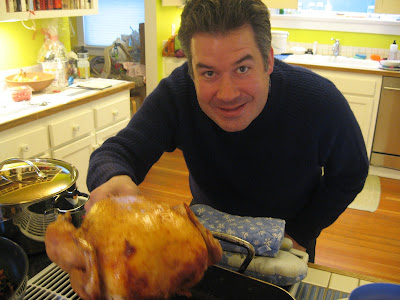
Resting chicken before I tented it with foil.

The flavor, with the fennel and red pepper, was really lovely. We overcooked it a tad, so the breast meat wasn't as moist as I like, but the flavorings were worth doing again for sure.
We had ganache-filled and cream-cheese-frostinged mini cupcakes for dessert, and once again I forgot to photograph them with their pretty pink frosting on. Here's what it looked like after we had consumed a dozen.

Spice-Rubbed Roast Chicken
1 t fennel seed
1/4 t red pepper flakes
1 1/2 t kosher salt
1/2 t ground black pepper
bunch fresh thyme
4 lb roasting chicken, at room temperature
Preheat oven to 400 degrees. Combine first four ingredients in mortar and pestle and grind to crack fennel seeds. Remove giblets and excess fat from chicken cavity, and rub chicken inside and out with salt mixture. Stuff thyme inside cavity. Put chicken in roasting pan and roast for about an hour, or until thigh temp is 165 and breast no more than 170. Remove from oven and let rest 10-15 minutes before carving.
Here it is before popping it in the oven (note: this is not a four-pound chicken! It was the last one in the coop that day, so it's a 5.25-pounder).

Sous-chef/dinner guest MWR brandishing the chicken as we flip it onto its tummy to rest.

Resting chicken before I tented it with foil.

The flavor, with the fennel and red pepper, was really lovely. We overcooked it a tad, so the breast meat wasn't as moist as I like, but the flavorings were worth doing again for sure.
We had ganache-filled and cream-cheese-frostinged mini cupcakes for dessert, and once again I forgot to photograph them with their pretty pink frosting on. Here's what it looked like after we had consumed a dozen.

Monday, January 14, 2008
Three Months Old
The bebe turned three months old this weekend, and she's still a dreamy baby. Still sleeps and eats great, and she's generally happy. At our big shindig last weekend, a friend was holding her for a while and said, "Is she always this chill?" Yeah, pretty much. She kicks her legs, waves her arms, coos (a LOT--definitely more of a talker like my side of the family, except that she doesn't interrupt!) and smiles, and she's starting to bat at things and clutch and pick at my clothing while eating.

Today I dressed her up in her utterly gorgeous and utterly impractical (cashmere blend, trimmed in hand-dyed silk!?!? It's all my fault, though, because I picked the materials) outfit made by her Auntie K. The color goes just perfectly with her eyes.


A bonus shot of sweet Number Two:

Oh, and since I mentioned the shindig, I'll give just a brief rundown: 14 lbs of slow-roasted Boston butt; 10 lbs of russets + 3 lbs of garnet yams + 1 bunch of kale + one large yellow onion made into orange and green mashed potatoes; an assortment of side dishes brought by thoughtful guests; killer pumpkin bread pudding with bourbon toffee sauce made by sil J; 28 people for dinner; four tables, including in the living room and entry hall, plus two people on the couch; $260 raised for the Sisters of the Road (next year the designated receptacle will be more clearly marked so no one forgets). The party can't keep growing the way it's been doing and still occur at my house, so I'm not sure what we'll end up doing. Limit attendance to the first x number of responders? Cull the guest list? Start offending people so they don't want to come, anyway? Change the date to a warmer time of year so we can set up the party tent in the back yard?
Oh, and because I know you want to know, my washing machine is still broken, which means all the table linens from the party are in a pile on my bedroom floor. We're supposed to have a new motor by Wednesday at the latest.

Today I dressed her up in her utterly gorgeous and utterly impractical (cashmere blend, trimmed in hand-dyed silk!?!? It's all my fault, though, because I picked the materials) outfit made by her Auntie K. The color goes just perfectly with her eyes.


A bonus shot of sweet Number Two:

Oh, and since I mentioned the shindig, I'll give just a brief rundown: 14 lbs of slow-roasted Boston butt; 10 lbs of russets + 3 lbs of garnet yams + 1 bunch of kale + one large yellow onion made into orange and green mashed potatoes; an assortment of side dishes brought by thoughtful guests; killer pumpkin bread pudding with bourbon toffee sauce made by sil J; 28 people for dinner; four tables, including in the living room and entry hall, plus two people on the couch; $260 raised for the Sisters of the Road (next year the designated receptacle will be more clearly marked so no one forgets). The party can't keep growing the way it's been doing and still occur at my house, so I'm not sure what we'll end up doing. Limit attendance to the first x number of responders? Cull the guest list? Start offending people so they don't want to come, anyway? Change the date to a warmer time of year so we can set up the party tent in the back yard?
Oh, and because I know you want to know, my washing machine is still broken, which means all the table linens from the party are in a pile on my bedroom floor. We're supposed to have a new motor by Wednesday at the latest.
Thursday, December 6, 2007
There's No Place Like Utard for the Holidays
We're heading to the Wasatch Front for Christmas, and it occurs to me that if I start planning NOW, we might actually be able to see non-family friends who live or spend the holidays there. My current thinking is to have crazy potluck open-house get-togethers on either/both Boxing Day (December 26) or New Year's Day. So, if you don't live in Utah but are planning on being there for the holidays, or if you live in Utah and think I might not have your correct contact info, and you think you'd like to see me and/or my child(ren), let me know.
Monday, December 3, 2007
Olio
Well, I'm finally about done with the last of the Thanksgiving cleanup. No, really! The last thing was to wash and press all those beautiful lace table linens that came from my grandmother. The trouble is, to get them (or any fine table linens, made of linen or cotton) beautifully shiny and smooth, they have to be pressed while thoroughly damp, and not just from spraying them right before ironing. They have to be damp for a while, so the fibers can relax. Since I have a front-loading washer that spins as fast as my car's engine at freeway cruising speeds, they are perfect for pressing pretty much right out of the washer. So I waited to wash them until I thought I'd have a chance to get around to ironing them right after. That chance finally came last night and this morning.
I did not grow up with cloth napkins--strange for someone whose mother seemed so to love ironing. But I guess with six kids the laundry load was already monumental, so perhaps not so strange after all. Anyway, somewhere along the line I decided I liked using cloth napkins, so any time we eat in the dining room, that's what we use. I have plain white cotton napkins, variously colored ones that match placemat sets (I'm not generally a tablecloth kind of gal, as you may have noticed from pictures of my table), and a few sets of white and ecru linen ones that I bought at an estate sale. More than I can realistically use, really.
Anyway, I love using cloth napkins for anything fancier than a weeknight family dinner. It took me a while to become comfortable really wiping my mouth on them, but now I don't hold back--I suppose it helps that I never wear lipstick, which might give me pause. But with the aforementioned front-loader (which can also achieve a water temperature of 205 degrees Fahrenheit), they almost always come clean.
Been busy lately, trying to get birth announcements out, plus Christmas cards, and then party invitations; Christmas shopping; another house project (I know, I said I was done!); getting back to teaching choir at Number One's school; and just plain old taking care of the kids. The house project is related to this summer's slew of projects, so not really something new. Just a couple of smaller things to help make all the $$ we spent this summer last longer.
As for the kids, well! I'm tempted to start calling the bebe Genius Baby, because Saturday night she slept for over eight hours straight. Even better, they were almost exactly coincidental with the hours that I wanted to sleep! Sunday was a good day. That was the first time she'd slept that long (she's only seven weeks old, after all), but she does regularly go five or even six hours at a stretch. Good girl.
We've never yet had to make a trip to the emergency room for one of the kids, but I feel quite certain that we will have to eventually. Yesterday, Number Two was running around in circles in the living room and kind of sort of falling down on purpose. Of course, on about the second time he landed right on his face and gave himself The Fattest Lip Ever.

I'm also really loving his language these days. He's stringing together longer sentences, but still in a rather staccato fashion, and with adorable Toddler Approximate Pronunciation. Some words are beautifully clear, and others can only be understood in context. Ls are pronounced either as Ws (weft instead of left--he knows his lefts and rights, btw) or Ys (yehyoh for yellow), depending. Combined consonants including S drop one letter (suck instead of stuck, for example), but not always the second one. "Small" is pronounced with a nasal exhalation before the M. Longer words are particularly susceptible to elisions, additions and transpositions--"diffeff" for "different," etc. Fortunately, he's pretty good about repeating himself when asked, so we can usually communicate pretty well.
I have realized that I don't write much about Number One compared to the younger two. Partly I think this is because he spends most of his days at school, and when he's home he's frequently entertaining himself. He also is turning into a teenager before his time, so not only are the things he does less cute and endearing, he'd probably be mortified if he knew that and what I was writing about him. I will say one thing: he's decided to be Draco Malfoy next Halloween. Won't that be perfect?
Edited to add that I think it might actually be "yeft" instead of "weft," and I forgot the cutest one of all: "movie" is pronounced "moozhee."
I did not grow up with cloth napkins--strange for someone whose mother seemed so to love ironing. But I guess with six kids the laundry load was already monumental, so perhaps not so strange after all. Anyway, somewhere along the line I decided I liked using cloth napkins, so any time we eat in the dining room, that's what we use. I have plain white cotton napkins, variously colored ones that match placemat sets (I'm not generally a tablecloth kind of gal, as you may have noticed from pictures of my table), and a few sets of white and ecru linen ones that I bought at an estate sale. More than I can realistically use, really.
Anyway, I love using cloth napkins for anything fancier than a weeknight family dinner. It took me a while to become comfortable really wiping my mouth on them, but now I don't hold back--I suppose it helps that I never wear lipstick, which might give me pause. But with the aforementioned front-loader (which can also achieve a water temperature of 205 degrees Fahrenheit), they almost always come clean.
Been busy lately, trying to get birth announcements out, plus Christmas cards, and then party invitations; Christmas shopping; another house project (I know, I said I was done!); getting back to teaching choir at Number One's school; and just plain old taking care of the kids. The house project is related to this summer's slew of projects, so not really something new. Just a couple of smaller things to help make all the $$ we spent this summer last longer.
As for the kids, well! I'm tempted to start calling the bebe Genius Baby, because Saturday night she slept for over eight hours straight. Even better, they were almost exactly coincidental with the hours that I wanted to sleep! Sunday was a good day. That was the first time she'd slept that long (she's only seven weeks old, after all), but she does regularly go five or even six hours at a stretch. Good girl.
We've never yet had to make a trip to the emergency room for one of the kids, but I feel quite certain that we will have to eventually. Yesterday, Number Two was running around in circles in the living room and kind of sort of falling down on purpose. Of course, on about the second time he landed right on his face and gave himself The Fattest Lip Ever.

I'm also really loving his language these days. He's stringing together longer sentences, but still in a rather staccato fashion, and with adorable Toddler Approximate Pronunciation. Some words are beautifully clear, and others can only be understood in context. Ls are pronounced either as Ws (weft instead of left--he knows his lefts and rights, btw) or Ys (yehyoh for yellow), depending. Combined consonants including S drop one letter (suck instead of stuck, for example), but not always the second one. "Small" is pronounced with a nasal exhalation before the M. Longer words are particularly susceptible to elisions, additions and transpositions--"diffeff" for "different," etc. Fortunately, he's pretty good about repeating himself when asked, so we can usually communicate pretty well.
I have realized that I don't write much about Number One compared to the younger two. Partly I think this is because he spends most of his days at school, and when he's home he's frequently entertaining himself. He also is turning into a teenager before his time, so not only are the things he does less cute and endearing, he'd probably be mortified if he knew that and what I was writing about him. I will say one thing: he's decided to be Draco Malfoy next Halloween. Won't that be perfect?
Edited to add that I think it might actually be "yeft" instead of "weft," and I forgot the cutest one of all: "movie" is pronounced "moozhee."
Friday, November 23, 2007
Dandy Dinde


We had a crazy crowd chez Chovy yesterday. We hosted three other young families, so there were children aged 7, 7, 5, 4, 4, 2, 2, 2, 2, and zero (yes, that means the adults were outnumbered--a childless couple did show up for desserts, which made things briefly even, at least on paper). My idea was that more guests => less for any one person to prepare, which turned out to be just right. And the kids made less chaos than I had feared (thanks to starting at a regular dinner hour, being pretty well prepared, and having a favorite movie for them to watch after they had inhaled their dinners and the adults were still eating).
I made the turkey, gravy, stuffing, mashed potatoes, and pumpkin pie. Others brought the green beans with slivered almonds, yam souffle, rolls, pecan pie, apple pie à la mode, mint brownies, fruit pizza, and pumpkin chocolate chip cookies. Everything was delicious. We had a two-year-old table (the coffee table with kid chairs, moved into the dining room bay window--Number Two was the only toddler who actually sat and ate for any appreciable amount of time), a kid table (all boys!) in the breakfast room, and a grownup table set with my grandmother's sterling and linens.
I thought the turkey turned out fabulously well this year. I bought a natural turkey, but did absolutely nothing special to prepare it (I have a newborn, remember?), just loaded the stuffing, put it on the roasting rack and shoved it in the oven at 425° for a half-hour, then lowered the temp to 350° for most of the duration. I tried to use my oven's probe so I wouldn't have to keep checking the temperature, but had a hard time finding a good spot to stick it because (this year's big experiment) I put the turkey on the rack breast side down, AND LEFT IT THAT WAY THE WHOLE TIME. There are lots of recipes that recommend putting the turkey prone for part of the cooking time, but they all say to turn it supine at some point so it looks better. Well, I don't care what it looks like! What with resting and carving ahead of time, no one other than me and the carver sees it whole. I only care what it tastes like. So, I would say this experiment was an unqualified success. With no brining, and no basting, I had breast meat that was juicy--hooray!
The stuffing was also primo. I made a loaf of plain white bread in my bread machine (remember how trendy these used to be? now I only use it once a year), cut it into half-inch cubes, and dried it in the oven. Right before loading, I sautéed in a few tablespoons of butter a large onion and four or five ribs of celery, finely chopped, and added a lot of finely chopped herbs (a whole bunch of parsley, and fistfuls of thyme and sage from the garden) at the end. After tossing the veggies/herbs with the bread cubes, only about half of it fit in the turkey's two cavities, so the other half got tossed with two cups homemade chicken broth and put into the crock pot on low. Before serving, I mixed both parts together. Yum--the stuffing was the one dinner item I didn't parcel out to send home with the guests; I just like it too much to share.
As I mentioned, the pie crust using part leaf lard (4 T, with 6 T butter) turned out flaky and fine. I can hardly wait to use it in a crust I'll be eating right away, and not the next day. The filling was the good old stand-by, the recipe straight off the side of the Libby's can. To me, it just tastes how it oughter.
Hope you all had a wonderful holiday!
Sunday, November 18, 2007
Jeg elsker gjetost
Saturday was book group, to discuss The Time Traveler's Wife by Audrey Niffenegger. This book is a great book group book, with lots to talk about and an engaging plot. The book is set in Chicago and Western Michigan, which didn't do much to inspire me culinarily. However, in one scene a couple of the characters eat at Ann Sather's, a Chicago institution serving Swedish and American food. I've eaten at Ann Sather's, plus I grew up eating some Norwegian food, plus I had lunch at Broder last week, SO, I decided a Scandinavian menu was in order.
We started with gjetost, the brown, nutty, caramelized Norwegian goat cheese (gjet = goat, ost = cheese; despite what I thought as a kid, it has nothing to do with toast). We ate it the way my dad served it to us as part of Sunday evening "snack," back in the days before the consolidated meeting schedule: Kavli, thinly spread with butter and honey, then topped with thinly-sliced cheese. Divine.
The main course (on the light side, since I wanted everyone to have plenty of room for the finisher): baked scrambled eggs with smoked chinook salmon or golden trout, and havarti and jarlsberg cheeses; baby greens with raspberry vinaigrette and hazelnuts. To make the baked eggs, I put a slice of artisan bread (trimmed to fit) in the bottom of the ramekin, topped it with chunks of salmon/trout and havarti and finely grated jarlsberg, then poured the egg mixture (10 eggs for 8 8-oz ramekins, plus about 1/2 C cream and 1/2 C milk, lightly salted and peppered) over the top and baked at 325° for about 40 minutes--until puffed and not wobbly in the middle.
The really exciting part of brunch: the sourdough aebleskivers, with buttermilk syrup and marionberry and lingonberry jams. There are lots of aebleskiver recipes out there, mostly just variations on pancake and waffle recipes. They're all good, but the sourdough ones are about a million times better.
To make sourdough starter, mix 2 C flour and 2 C water in a large plastic or glass bowl, using a wooden spoon. Lightly cover with a thin dishtowel and leave at warm room temperature for 3-4 days, stirring a few times a day. When you're ready to use the starter, save some for future use (so you don't have to start over every time--1/2 C or so in a jar in the fridge that you stir every few days, and add flour to every so often), then mix in 1 beaten egg, 1/8 C oil (more if you're going to make waffles with the batter), and a mixture of 1 T sugar, 1 t baking soda and 1 t salt. When you mix in the dry ingredients, the batter will about double in volume. Cook it up right away (before the batter completely deflates), and enjoy!!
We started with gjetost, the brown, nutty, caramelized Norwegian goat cheese (gjet = goat, ost = cheese; despite what I thought as a kid, it has nothing to do with toast). We ate it the way my dad served it to us as part of Sunday evening "snack," back in the days before the consolidated meeting schedule: Kavli, thinly spread with butter and honey, then topped with thinly-sliced cheese. Divine.
The main course (on the light side, since I wanted everyone to have plenty of room for the finisher): baked scrambled eggs with smoked chinook salmon or golden trout, and havarti and jarlsberg cheeses; baby greens with raspberry vinaigrette and hazelnuts. To make the baked eggs, I put a slice of artisan bread (trimmed to fit) in the bottom of the ramekin, topped it with chunks of salmon/trout and havarti and finely grated jarlsberg, then poured the egg mixture (10 eggs for 8 8-oz ramekins, plus about 1/2 C cream and 1/2 C milk, lightly salted and peppered) over the top and baked at 325° for about 40 minutes--until puffed and not wobbly in the middle.
The really exciting part of brunch: the sourdough aebleskivers, with buttermilk syrup and marionberry and lingonberry jams. There are lots of aebleskiver recipes out there, mostly just variations on pancake and waffle recipes. They're all good, but the sourdough ones are about a million times better.
To make sourdough starter, mix 2 C flour and 2 C water in a large plastic or glass bowl, using a wooden spoon. Lightly cover with a thin dishtowel and leave at warm room temperature for 3-4 days, stirring a few times a day. When you're ready to use the starter, save some for future use (so you don't have to start over every time--1/2 C or so in a jar in the fridge that you stir every few days, and add flour to every so often), then mix in 1 beaten egg, 1/8 C oil (more if you're going to make waffles with the batter), and a mixture of 1 T sugar, 1 t baking soda and 1 t salt. When you mix in the dry ingredients, the batter will about double in volume. Cook it up right away (before the batter completely deflates), and enjoy!!
Saturday, September 8, 2007
Canadian Book but NOT Canadian Food
Usually I try to make the menu in some way go along with the book we read for book group, but not this time. The book was The Robber Bride by Margaret Atwood, and the menu was on the Italian side of Continental. It didn't really come together into a true three-course meal, as it often does, but I think everyone left the table more than satisifed.
For the main part of brunch, we gorged ourselves on salumi and cheese with Panzanella Black Pepper and Starr Ridge Olive Oil crackers. The cheeses were Tenerone Tre Latte (a soft aged cheese made from cow, goat and sheep milk), Formaggio Crucolo, Toma Piemontese, and Fromager d'Affinois (so help me, I can't leave the shop without a chunk of that last one). The salumi were a domestic prosciutto, mortadella, a mild Venetian copa, salame toscano, salame genovese, and sopressata. All were delicious (and Number Two was only too happy to help Mavis finish the leftovers!). The salumi platter was garnished with yellow and orange cherry tomatoes (the yellow ones from my garden), and I also served a roasted heirloom tomato tart (again, some from my garden, some not).
Oh, the tart was good. Here's what was left over (yes, once again I forgot to take pictures until the food was just about gone!):

I was inspired by pictures and a mention over at She Who Eats--I've had the notes to make it in my Palm for a year and a half! SWE made her tart with a short pastry crust, but I was inspired by a recipe in Cook's Illustrated to try a puff pastry crust instead. Maybe next time I'll try the short crust. So, here's how I made it:
For dessert, we had a plum cake, the recipe for which was in the recent July-August Cook's Illustrated. I've never liked plums, but this was absolutely to die for. I will be making a more concerted effort in the future to harvest the basically unreachable plums in the giant tree in our backyard (the four David could reach from a six-foot stepladder went into this cake).

As if the cake weren't enough, I also had a selection of wee delicious cookies from Two Tarts (scroll down to "Best Sister Act"): Hazelnut Bocconcini, Cashew Shortbread and Peanut Butter Creams. Yum!

For the main part of brunch, we gorged ourselves on salumi and cheese with Panzanella Black Pepper and Starr Ridge Olive Oil crackers. The cheeses were Tenerone Tre Latte (a soft aged cheese made from cow, goat and sheep milk), Formaggio Crucolo, Toma Piemontese, and Fromager d'Affinois (so help me, I can't leave the shop without a chunk of that last one). The salumi were a domestic prosciutto, mortadella, a mild Venetian copa, salame toscano, salame genovese, and sopressata. All were delicious (and Number Two was only too happy to help Mavis finish the leftovers!). The salumi platter was garnished with yellow and orange cherry tomatoes (the yellow ones from my garden), and I also served a roasted heirloom tomato tart (again, some from my garden, some not).
Oh, the tart was good. Here's what was left over (yes, once again I forgot to take pictures until the food was just about gone!):

I was inspired by pictures and a mention over at She Who Eats--I've had the notes to make it in my Palm for a year and a half! SWE made her tart with a short pastry crust, but I was inspired by a recipe in Cook's Illustrated to try a puff pastry crust instead. Maybe next time I'll try the short crust. So, here's how I made it:
Roasted Heirloom Tomato Tart
1 box Pepperidge Farm frozen puff pastry, thawed in the fridge overnight
egg for wash
1 small tub (7.5 oz) crème fraîche
1 t dijon mustard
6-8 medium (2-in diameter) heirloom tomatoes
3/4 t (about) kosher salt
leaves from 4-6 sprigs fresh thyme
freshly ground black pepper
grated parmesan
Preheat oven to 425° F. Gently unfold puff pastry on surface lightly dusted with flour. You can use some egg wash and a one-inch overlap to put the pieces together for one large tart, or use the sheets separately for two smaller tarts (what I did--I might try with just one big one next time). Using a pizza wheel, cut two one-inch-wide strips from one side, then two more strips from a perpendicular side. Brush the four edges of the main piece with egg wash, then lay strips around edges, pressing to seal, and trimming excess with pizza wheel. Brush whole surface with egg wash, grate a small amount of parmesan over it (focusing on the part inside the edges), then prick all over with a fork. Bake for 13 minutes, then reduce temperature to 350° and bake for an additional 13 minutes. Pastry will be puffed and golden brown. Put baking sheet on a rack to cool, and raise oven temperature back to 425°.
While pastry is baking, slice tomatoes a scant 1/4 inch thick, carefully cutting out cores, and eating the ends (SWE peeled her tomatoes before assembling the tart, which would be nice but is not absolutely necessary). Spread tomatoes in a single layer on a double layer of paper towels, sprinkle with kosher salt, and let sit for 20 minutes. Cover with another double layer of paper towels and gently squeeze away the moisture drawn out by the salt.
Mix together the crème fraîche and the dijon, and spread it in the bottom of the tart(s) (I pushed the inside of the shells down a little where they had puffed up--I guess I didn't fork them well enough before baking). Spread the tomatoes in overlapping rows, then top with freshly ground pepper and thyme leaves. Bake 15-20 minutes (I think I did closer to 20, but a little less would have been fine). Let cool for a few minutes, then cut with pizza wheel and serve.
For dessert, we had a plum cake, the recipe for which was in the recent July-August Cook's Illustrated. I've never liked plums, but this was absolutely to die for. I will be making a more concerted effort in the future to harvest the basically unreachable plums in the giant tree in our backyard (the four David could reach from a six-foot stepladder went into this cake).
Plum Cake
2 T red currant jelly
3 T brandy (or 1 T water--I didn't have any brandy on hand)
1 lb (10-ish) Italian prune plums (the small, dark purple, oval ones), halved and pitted (big round plums will work if you cut them into eighths and stir while cooking, but they won't look as pretty)
3/4 C unbleached all-purpose flour
3/4 C sugar
1/3 C slivered almonds
1/2 t baking powder
1/4 t table salt
6 T unsalted butter, cut into pieces, softened but still cool
1 large egg plus 1 large yolk, at room temperature
1 t vanilla extract
1/4 t almond extract
1. Melt jam and water in 10-inch nonstick skillet over medium heat (if using brandy, cook it 2-3 minutes, until reduced to a thick syrup). Remove from heat and place plums cut-side down in syrup. Return to medium heat and cook until plums shed their juices and thick syrup is again formed, about five minutes, shaking pan to prevent plums from sticking. Cool plums in pan, about 20 minutes.
2. Adjust oven rack to middle position and heat oven to 350°. Grease and flour (or use baking spray--much easier!) 9-in springform pan. Process sugar and almonds in food processor until nuts are finely ground, about 1 minute. Add flour, baking powder, and salt, and pulse to combine. Add butter and pulse until mixture resembles coarse sand, about ten 1-second pulses. Add eggs, vanilla, and almond extract and process until smooth, about 5 seconds, scraping bowl once if needed (batter will be very thick and heavy, pasty even).
3. Transfer batter to prepared pan; using spatula, spread batter evenly to pan edges and smooth surface. Stir plums to coat with syrup. Arrange plum halves, skin-side down, evenly over surface of batter, not touching pan edges, covering whole surface, and NOT pressing them down into the batter (I did this a little and I think it's why a lot of my plums sank so my cake didn't look as pretty as Cook's did). Save syrupy juices. Bake until cake is golden brown and wooden skewer inserted into center comes out with a few crumbs attached, 40 to 50 minutes (45 was perfect for mine). Run paring knife around sides of cake to loosen. Cool in pan on wire rack until just warm or to room temperature, at least 30 minutes. Remove cake from pan, cut into wedges, and serve with lightly sweetened whipped cream and reserved pan juices.

As if the cake weren't enough, I also had a selection of wee delicious cookies from Two Tarts (scroll down to "Best Sister Act"): Hazelnut Bocconcini, Cashew Shortbread and Peanut Butter Creams. Yum!

Subscribe to:
Posts (Atom)