Showing posts with label culinary triumphs. Show all posts

Thursday, June 19, 2008

Nights of Spain

Of a recent Friday night, we had friends for dinner with a Spanish theme. No, I've never been to Spain (though one of my brothers went there on his mission)--I just had some Spanish chorizo in the freezer I wanted to use up. So, paella it would be. We started with a spread of Spanish cheeses, fig-almond paste, bread and crackers, and olives (the olives aren't in this picture, but you can see them in the first picture of the big table--there were medium-sized anchovy-stuffed ones, and little tiny ones).


Then the paella. It's not really that short on ingredients, but when you're making basically a one-dish meal, you get a lot of bang for your food-prep buck. I've never made a traditional recipe (this was my first paella), and I don't know why I'd bother when Cook's Illustrated has already done the paring down, and this one was so tasty!
Paella
adapted from Cook's Illustrated, May/June 2005
serves 6 (for our crowd of 10, I basically 1.5xed this recipe, and it was just right)

1 lb extra-large (21/25) shrimp, peeled and deveined
table salt and ground black pepper
olive oil
8-9 medium garlic cloves, pressed
1 lb boneless skinless chicken thighs, trimmed and halved crosswise
1 red bell pepper, roasted, skinned, and cut into strips (I served these separately because of an allergy among our guests)
8 oz Spanish chorizo, sliced 1/2" thick on the bias
1 medium onion, chopped fine
1 14.5-oz can diced tomatoes, drained, chopped, and drained again
2 C Valencia rice
3 C homemade chicken broth
1/3 C dry white wine
1/2 t saffron threads, crushed
1 bay leaf
1 doz mussels, scrubbed and beards snipped
1/2 C frozen peas, thawed
2 T chopped fresh flat-leaf parsley
1 lemon, cut into wedges, for serving

1. Preheat oven to 350 (since I was using a cast-iron dutch oven, I put the lid in the preheating oven so a cold lid wouldn't slow down cooking later). Toss shrimp, 1/4 t salt, 1/4 t black pepper, 1 T oil, and 1 t garlic in medium bowl; cover and refrigerate. Season chicken with salt and pepper and set aside.


2. Heat 2 t oil in large dutch oven over medium-high heat until shimmering. Brown chicken pieces in a single layer (not moving them while they cook), then transfer to a bowl. Reduce heat to medium and add chorizo to pot. Cook, stirring frequently, until quite browned and beginning to render fat, then transfer to bowl with chicken.

3. Adjust fat in pot to equal 2 T and heat until shimmering. Add onion and cook, stirring frequently, until softened, then add garlic and cook until fragrant.


Stir in tomatoes and cook until mixture begins to darken and thicken slightly, about 3 minutes. Stir in rice and cook until well coated. Stir in wine and cook until evaporated/absorbed, then add broth, saffron, bay, and 1/2 t salt. Return chicken and chorizo to pot, increase heat to medium-high and bring to boil, uncovered, stirring occasionally. Cover pot and transfer to oven; cook until rice absorbs almost all liquid, 15 minutes (or so). Pull out pot and uncover. Scatter shrimp over rice, nest mussels in rice hinged side down, arrange pepper strips in pinwheel pattern, and scatter peas over top. Cover and return to oven, cooking until shrimp are opaque and mussels have opened, 10-12 minutes (mine needed a bit more time on both cooking segments, probably because I was making a larger batch).

4. Let stand, covered, 5 minutes before serving. Toss any unopened mussels, sprinkle with parsley, and serve, passing lemon wedges at the table.

We had Izze sodas to drink: pear, pomegranate and clementine.


After the paella I served a simple salad of mixed greens, aged Spanish Mohan cheese, and grape tomatoes, dressed with EVOO and sherry vinegar. For dessert, fresh strawberry ice cream!

Sunday, November 18, 2007

Jeg elsker gjetost

Saturday was book group, to discuss The Time Traveler's Wife by Audrey Niffenegger. This book is a great book group book, with lots to talk about and an engaging plot. The book is set in Chicago and Western Michigan, which didn't do much to inspire me culinarily. However, in one scene a couple of the characters eat at Ann Sather's, a Chicago institution serving Swedish and American food. I've eaten at Ann Sather's, plus I grew up eating some Norwegian food, plus I had lunch at Broder last week, SO, I decided a Scandinavian menu was in order.

We started with gjetost, the brown, nutty, caramelized Norwegian goat cheese (gjet = goat, ost = cheese; despite what I thought as a kid, it has nothing to do with toast). We ate it the way my dad served it to us as part of Sunday evening "snack," back in the days before the consolidated meeting schedule: Kavli, thinly spread with butter and honey, then topped with thinly-sliced cheese. Divine.

The main course (on the light side, since I wanted everyone to have plenty of room for the finisher): baked scrambled eggs with smoked chinook salmon or golden trout, and havarti and jarlsberg cheeses; baby greens with raspberry vinaigrette and hazelnuts. To make the baked eggs, I put a slice of artisan bread (trimmed to fit) in the bottom of the ramekin, topped it with chunks of salmon/trout and havarti and finely grated jarlsberg, then poured the egg mixture (10 eggs for 8 8-oz ramekins, plus about 1/2 C cream and 1/2 C milk, lightly salted and peppered) over the top and baked at 325° for about 40 minutes--until puffed and not wobbly in the middle.

The really exciting part of brunch: the sourdough aebleskivers, with buttermilk syrup and marionberry and lingonberry jams. There are lots of aebleskiver recipes out there, mostly just variations on pancake and waffle recipes. They're all good, but the sourdough ones are about a million times better.

To make sourdough starter, mix 2 C flour and 2 C water in a large plastic or glass bowl, using a wooden spoon. Lightly cover with a thin dishtowel and leave at warm room temperature for 3-4 days, stirring a few times a day. When you're ready to use the starter, save some for future use (so you don't have to start over every time--1/2 C or so in a jar in the fridge that you stir every few days, and add flour to every so often), then mix in 1 beaten egg, 1/8 C oil (more if you're going to make waffles with the batter), and a mixture of 1 T sugar, 1 t baking soda and 1 t salt. When you mix in the dry ingredients, the batter will about double in volume. Cook it up right away (before the batter completely deflates), and enjoy!!

Saturday, September 8, 2007

Canadian Book but NOT Canadian Food

Usually I try to make the menu in some way go along with the book we read for book group, but not this time. The book was The Robber Bride by Margaret Atwood, and the menu was on the Italian side of Continental. It didn't really come together into a true three-course meal, as it often does, but I think everyone left the table more than satisifed.

For the main part of brunch, we gorged ourselves on salumi and cheese with Panzanella Black Pepper and Starr Ridge Olive Oil crackers. The cheeses were Tenerone Tre Latte (a soft aged cheese made from cow, goat and sheep milk), Formaggio Crucolo, Toma Piemontese, and Fromager d'Affinois (so help me, I can't leave the shop without a chunk of that last one). The salumi were a domestic prosciutto, mortadella, a mild Venetian copa, salame toscano, salame genovese, and sopressata. All were delicious (and Number Two was only too happy to help Mavis finish the leftovers!). The salumi platter was garnished with yellow and orange cherry tomatoes (the yellow ones from my garden), and I also served a roasted heirloom tomato tart (again, some from my garden, some not).

Oh, the tart was good. Here's what was left over (yes, once again I forgot to take pictures until the food was just about gone!):


I was inspired by pictures and a mention over at She Who Eats--I've had the notes to make it in my Palm for a year and a half! SWE made her tart with a short pastry crust, but I was inspired by a recipe in Cook's Illustrated to try a puff pastry crust instead. Maybe next time I'll try the short crust. So, here's how I made it:
Roasted Heirloom Tomato Tart

1 box Pepperidge Farm frozen puff pastry, thawed in the fridge overnight
egg for wash
1 small tub (7.5 oz) crème fraîche
1 t dijon mustard
6-8 medium (2-in diameter) heirloom tomatoes
3/4 t (about) kosher salt
leaves from 4-6 sprigs fresh thyme
freshly ground black pepper
grated parmesan

Preheat oven to 425° F. Gently unfold puff pastry on surface lightly dusted with flour. You can use some egg wash and a one-inch overlap to put the pieces together for one large tart, or use the sheets separately for two smaller tarts (what I did--I might try with just one big one next time). Using a pizza wheel, cut two one-inch-wide strips from one side, then two more strips from a perpendicular side. Brush the four edges of the main piece with egg wash, then lay strips around edges, pressing to seal, and trimming excess with pizza wheel. Brush whole surface with egg wash, grate a small amount of parmesan over it (focusing on the part inside the edges), then prick all over with a fork. Bake for 13 minutes, then reduce temperature to 350° and bake for an additional 13 minutes. Pastry will be puffed and golden brown. Put baking sheet on a rack to cool, and raise oven temperature back to 425°.

While pastry is baking, slice tomatoes a scant 1/4 inch thick, carefully cutting out cores, and eating the ends (SWE peeled her tomatoes before assembling the tart, which would be nice but is not absolutely necessary). Spread tomatoes in a single layer on a double layer of paper towels, sprinkle with kosher salt, and let sit for 20 minutes. Cover with another double layer of paper towels and gently squeeze away the moisture drawn out by the salt.

Mix together the crème fraîche and the dijon, and spread it in the bottom of the tart(s) (I pushed the inside of the shells down a little where they had puffed up--I guess I didn't fork them well enough before baking). Spread the tomatoes in overlapping rows, then top with freshly ground pepper and thyme leaves. Bake 15-20 minutes (I think I did closer to 20, but a little less would have been fine). Let cool for a few minutes, then cut with pizza wheel and serve.

For dessert, we had a plum cake, the recipe for which was in the recent July-August Cook's Illustrated. I've never liked plums, but this was absolutely to die for. I will be making a more concerted effort in the future to harvest the basically unreachable plums in the giant tree in our backyard (the four David could reach from a six-foot stepladder went into this cake).
Plum Cake

2 T red currant jelly
3 T brandy (or 1 T water--I didn't have any brandy on hand)
1 lb (10-ish) Italian prune plums (the small, dark purple, oval ones), halved and pitted (big round plums will work if you cut them into eighths and stir while cooking, but they won't look as pretty)
3/4 C unbleached all-purpose flour
3/4 C sugar
1/3 C slivered almonds
1/2 t baking powder
1/4 t table salt
6 T unsalted butter, cut into pieces, softened but still cool
1 large egg plus 1 large yolk, at room temperature
1 t vanilla extract
1/4 t almond extract

1. Melt jam and water in 10-inch nonstick skillet over medium heat (if using brandy, cook it 2-3 minutes, until reduced to a thick syrup). Remove from heat and place plums cut-side down in syrup. Return to medium heat and cook until plums shed their juices and thick syrup is again formed, about five minutes, shaking pan to prevent plums from sticking. Cool plums in pan, about 20 minutes.

2. Adjust oven rack to middle position and heat oven to 350°. Grease and flour (or use baking spray--much easier!) 9-in springform pan. Process sugar and almonds in food processor until nuts are finely ground, about 1 minute. Add flour, baking powder, and salt, and pulse to combine. Add butter and pulse until mixture resembles coarse sand, about ten 1-second pulses. Add eggs, vanilla, and almond extract and process until smooth, about 5 seconds, scraping bowl once if needed (batter will be very thick and heavy, pasty even).

3. Transfer batter to prepared pan; using spatula, spread batter evenly to pan edges and smooth surface. Stir plums to coat with syrup. Arrange plum halves, skin-side down, evenly over surface of batter, not touching pan edges, covering whole surface, and NOT pressing them down into the batter (I did this a little and I think it's why a lot of my plums sank so my cake didn't look as pretty as Cook's did). Save syrupy juices. Bake until cake is golden brown and wooden skewer inserted into center comes out with a few crumbs attached, 40 to 50 minutes (45 was perfect for mine). Run paring knife around sides of cake to loosen. Cool in pan on wire rack until just warm or to room temperature, at least 30 minutes. Remove cake from pan, cut into wedges, and serve with lightly sweetened whipped cream and reserved pan juices.


As if the cake weren't enough, I also had a selection of wee delicious cookies from Two Tarts (scroll down to "Best Sister Act"): Hazelnut Bocconcini, Cashew Shortbread and Peanut Butter Creams. Yum!

Friday, July 13, 2007

Potluck Provisions

Went to a potluck tonight. I'd been planning all week on taking the couscous salad, but then when I was out in the yard picking a few sugarsnap peas I noticed that the rhubarb is looking remarkably robust for this time of year. Typically rhubarb kind of wilts away in the summer heat, only to rebound when the fall rains and cooler temperatures arrive. But my rhubarb is planted on the east side of my apple tree, so it gets full sun in the spring before the apple tree leafs out, and then only a little morning sun in the heat of summer. So, I made the couscous salad, and also a (sorry no picture--we were late leaving for the party and it's all gone now!):
Rhubarb-Ginger Tart

Pastry:
1 1/4 C flour
1 T sugar
1/2 t salt
1/2 C unsalted butter, frozen and then thawed just enough to cut with a sharp paring knife
2-3 T ice-cold water

Filling:
about 4 C rhubarb, halved lengthwise and cut crosswise into 1/4-inch slices
1 C sugar
1 T cornstarch
1/4-1/3 C chopped crystallized ginger
pinch of salt

Mix the filling ingredients together and let sit, stirring occasionally, while you make the pastry. This will draw the juices out of the rhubarb and dissolve the sugar.

For the pastry, briefly blend the dry ingredients in the food processor. Scatter 1/2-inch cubes of butter over the top, and pulse until the largest pieces of butter are petite-pea-sized. Sprinkle 2 T ice-cold water and pulse a couple more times. Test dough by pinching to see if it will hold together without being too crumbly, and add more water if needed. Do not overprocess. Pour dough mixture onto floured pastry cloth or board, and press together, being careful to handle it only as much as it absolutely necessary (if it seems sticky, wrap it in plastic wrap and refrigerate it for 1/2 hour).

Preheat oven to 400 degrees. Roll pastry into a circle approximately 1/8 inch thick and 11-12 inches in diameter. Carefully transfer pastry to a 9-inch tart pan, rolling edges under where they overlap the sides. Press the sides into the pan crenellations so they are of an even thickness. Pour rhubarb mixture into pastry-lined pan, put on a rimmed baking sheet and bake for 40-50 minutes, until pastry is golden, rhubarb is tender and juices are bubbling. Let cool until just barely warm (so the juices aren't too runny) before serving with vanilla ice cream.

Saturday, June 30, 2007

Finally, Food to Post About

Summer is rerun season, no less in my kitchen than on TV. We've been eating lots of good things, just not much new or different (I can only write about Copper River sockeye so many times, right?). Tonight's menu was something I came up with much earlier in the week, but didn't get around to making until today. Its genesis came last weekend, when we had a leftover half-baguette and half a pound of pork-sage sausage. Hmmm, I thought, maybe I should make a strata. And what better to accompany a rich, creamy, cheesy, sausagey, eggy dish than a light potato-veggie salad? So here they are. The strata is adapted from Cooks' Illustrated from several years back (useful mostly for knowing the basic proportions of stuff to fit in the pan--my combination of add-ins was not one they featured), and the salad was inspired by one I've made from the Barefoot Contessa cookbook, and also by happy hours passed recently watching The Naked Chef on BBC America. Mavis and I liked everything. The wee feller liked (snarfed!) the strata, but had to be cajoled to eat even those parts of the salad he will admit to liking (asparagus, peas, potatoes).
3S Strata

1/2 baguette
couple tablespoons butter
1/2 lb sausage
3 shallots, finely chopped
big handful fresh spinach, stemmed and coarsely chopped
a little olive oil
about 6 oz cheddar cheese, grated
6 eggs
1 3/4 C half and half
1/2 t kosher salt
freshly ground pepper

Slice baguette into 1/2-inch slices and leave spread on a cookie sheet overnight to fully dry out (or put in 225-degree oven for a half hour). Spread each slice thinly with butter on one side. Heat olive oil in a nonstick frying pan over medium heat, then add sausage. Brown it, breaking it up into small chunks. When it's nearly cooked, add the shallot and keep sauteeing. When shallot is translucent and starting to brown, add spinach and saute a few minutes until fully wilted.

Arrange half of bread in one layer, buttered side up, in a buttered (or Pammed) 8x8 dish. Top with half of sausage-shallot-spinach mixture, then half of cheese, and repeat. Beat eggs with half and half and salt and pepper, then pour over the top. Put plastic wrap directly on the surface, weight the top, and put it in the fridge for at least an hour and as long as over night (I managed a couple of hours today).

When you're ready to cook it, take it out of the fridge and let it sit at room temperature while the oven is preheating to 325 degrees. Then bake for 50-55 minutes, until puffed and slightly pulled away from sides. Let cool on rack for five minutes, then serve.


Potato-Veggie Salad

1 1/2 lbs or so baby potatoes, boiled until just tender
1/3 C corn kernels (I used the first corn of the season, three tiny ears, but I think frozen would work well, too)
other veggies, blanched and cooled (I used a few fava beans, the last few spears of on-their-last-legs asparagus, a handful of green and yellow beans, a handful of sugar snap peas from the garden--you get the general idea)*
1/3 C finely chopped herbs (I used chives, basil, dill and parsley)
juice of 1/2 lemon (a couple of tablespoons)
about twice that much EVOO
salt and freshly ground pepper

Whisk herbs, lemon juice, olive oil and salt and pepper in medium bowl, then stir in warm potatoes. Stir in other ingredients and put in fridge to cool. Serve chilled or at room temperature.

*I think the perfect amounts of blanching time are: 1 minute each for favas, asparagus and sugar snap peas; 3 minutes for green and yellow beans. For corn, drop it into the boiling water, replace lid, then turn off heat and leave it in the pot at least 3-5 minutes or until you're ready for it. With this method it won't overcook.

Thursday, June 14, 2007

Baseball + Strawberries = True Love

Tonight was Number One's final baseball game, with pizza party immediately following. Because our last name is in the second half of the alphabet, we were assigned to bring a dessert. For some reason it occurred to me, and I could not banish the notion, that I should bring homemade strawberry ice cream to this event. So I looked through my books, took a guess as to how many times I should multiply a one-quart recipe for my larger ice-and-salt freezer machine (one quart being woefully insufficient for 14 Little League players and their families), and went to it. I made the custard last night (the original recipe does not call for any cooking, but since I'm not supposed to be eating raw eggs, I took the extra step), picked up some fresh-picked Hood strawberries this morning, and had it finished and in the basement freezer to cure before I went to pick up Number One from school. It could have used more curing time (I discovered when I started scooping and the middle of the canister was still quite soft), but that would have meant picking up the berries earlier, which just wasn't happening this morning.

Here's the recipe for a one-quart maker (which includes most frozen-canister or internal-freezer ice cream makers), adapted from the Ben & Jerry's Ice Cream book:

Sweet Cream Base:
2 eggs
3/4 C sugar
2 C cream
1 C milk

Whisk eggs until light and fluffy (1-2 minutes), then gradually add sugar and mix until fully blended, light and smooth (another minute). Whisk in cream and milk (I used my KitchenAid for this, but I had to mix in the last bit of liquid by hand because I tripled the recipe and the top of the whisk attachment would have been submerged. As it turned out, 2 1/2 times the recipe probably would have been plenty, and I might have even been okay with 2 times). If you're going to cook/pasteurize it, put in a heavy saucepan over medium heat, stirring frequently (at the beginning) and then constantly (as it gets hot) until it reaches 180 degrees. You will need to do this part the night before so it can cool down to 40 degrees before you put it in the ice cream freezer.

Strawberry addition:

1 pint strawberries, sliced
1/3 C sugar
juice of half a lemon
pinch of salt*
1 T vodka*

Mix all ingredients together, then let macerate for at least an hour. Next time I do it, I'll probably try for three or four. The original recipe calls for slicing before macerating and then mashing before mixing into the base; I diced, which probably would have worked great if I'd macerated longer. As it was the berries were just a tad icy. I used about half the called-for sugar, which was still plenty for my juicy and sweet Hoods. If you're using California berries with a firmer texture and blander flavor, use the whole amount. I used less lemon juice than this (after tripling) and regretted it, so use it all even though it sounds like quite a bit--I think it really needs the acidic punch to bring out the strawberry flavor. The last two ingredients I added based on a Cook's Illustrated recipe for peach ice cream, and they seemed like a good idea here as well. The salt just brings out the fruit flavor, and the vodka helps make a smoother, less icy ice cream. Certainly you couldn't detect it at all in the finished product.

When both the custard and the berries are fully chilled, mix them together (mashing the berries first if desired) and freeze according to your ice cream maker's instructions.

Sorry I don't have pictures for you tonight--I'm not 100% sure where my camera is at the moment. I'll try to take a picture when I eat the leftovers tomorrow, and add it to this post then.

Saturday, June 2, 2007

Three Junes in June

Our book group selection this time was Three Junes by Julia Glass, a National Book Award winner from a couple years back and a very enjoyable read. Part of the book takes place in Scotland, which I thought presented the perfect opportunity to make the recipe on the page before the Salmon-Wrapped Poached Eggs from last time: Oatmeal Brûlée with Macerated Berries from The Gourmet Cookbook. The weather has also been ideal this week, plus I didn't feel like cleaning my projects off my dining room table, so I set up a small table and large umbrella on the back patio. Instead of having a floral centerpiece, we were surrounded by my profusely blooming backyard. Unfortunately, I am lame so there aren't pictures--I didn't remember until everything was entirely consumed.

We started with a simple cheese course: Valentine from Ancient Heritage Dairy (featured this week in the Oregonian FOODday section), a soft sheep's-milk cheese, and fresh goat cheese with dill from Country Pride (both purchased at the Portland Farmers' Market this morning). Then on to the Oatmeal.
First, you macerate the berries in simple syrup with chopped fresh mint. I knew I would want to use the same berries for the strawberry shortcake for dessert, so I doubled the recipe here, using two pints of berries, two tablespoons of chopped fresh mint, and a simple syrup made from 1/2 C sugar and 1/2 C water. The recipe says to macerate for at least four hours. I think I ended up with about two hours before I started serving them, and they were very juicy and delicious. I think with our juicy local berries, it would probably be fine (and save a step) to macerate in just sugar, without making the syrup.

Put racks in upper and lower thirds of oven and preheat to 400 F.

Make the custard in two small bowls. In one you whip 1/4 C cream with a handheld mixer until it just holds stiff peaks. In the other you whisk (I used my handheld mixer, without rinsing the beaters in between) together another 1/4 C cream, two eggs, and 3 T brown sugar. Then gently combine the contents of the two bowls.

Then, cook 1 1/2 C old-fashioned oats in 3 C water (the usual proportions, according to the side of the Quaker box) until it's thick and tender. Divide between four flameproof shallow soup bowls and smooth with the back of a spoon. Pour custard over oatmeal. Bake until set, switching positions after 5 minutes. The recipe says 12 minutes, but I think a minute or two shorter would have worked. Remove from oven, sprinkle top of each with 1 t sugar (recipe calls for granulated; I used turbinado), and melt/caramelize with a blowtorch. Top with a scoop of the macerated berries and serve.

For dessert we had strawberry shortcake, using the other half of the macerated strawberries, lightly-sweetened whipped cream, and Southern-Style Shortcakes I made from a recipe that ran in the Oregonian (which I can't find online for some reason). I mostly ignored their method instructions, and used my regular method of cutting very cold butter into the dry ingredients using the Cuisinart, then adding the liquid and just barely mixing them before transferring the dough to a bowl for a last 5-second hand knead to stick everything together. I also skipped rolling and cutting (this dough was quite sticky) in favor of my scone method of patting the dough into a thick round and cutting into wedges with my bench scraper, and reserved a tablespoon or so of the liquid ingredients to brush on (and then sprinkle with sugar) before baking.
2 C all-purpose flour
3 T sugar
1 T baking powder
1/4 t salt (I used 1/2 t kosher salt instead)
1/2 C butter, almost frozen, cut into cubes (they called for softened, which is asking for tough biscuits IMO)
1 egg, beaten slightly
2/3 C half-and-half

We talked about picking our next book, but didn't do it. I would really like to read something meaty and juicy, along the lines of past favorite reads like Ahab's Wife or Daughter's Keeper. We mentioned The Robber Bride by Margaret Atwood as a possibility. And I've read interesting things about The Historian by Elizabeth Kostova (yes, I know you hated it, Janet). Any other marvelous suggestions from you, my faithful yet mostly silent readers?

Wednesday, May 23, 2007

It's That Time of Year Again

The roses are starting to bloom (not for nothing is this place called the City of Roses), and the first local strawberries are starting to appear at the market. Not the best varieties, yet, but still exponentially better than the pretty-yet-woody California imports. The day before Mothers' Day my sister was in town, and for a family dinner I put together this trifle:


I used about three pints of berries, one and a half purchased pound cakes, six egg yolks-worth of pastry cream, a pint of cream (whipped and sweetened), diced roasted hazelnuts, chopped crystallized ginger, and homemade rhubarb-ginger jam. I made it last year without the pastry cream, and it was delectable. Pound cake + pastry cream, though, is just a tad rich. I think if I use the pastry cream again, I'll use a lighter cake, like the chiffon cake I made for the Burns Supper trifle, or even an angel food cake.

The benefit to making the pastry cream, of course, is to have leftover egg whites to make into almond macaroons, which I did.

The most spectacular of my roses aren't blooming yet, but when I get back from my weekend in Utard (gotta see those new nephews!) I'll start snapping. Too bad this blog does not include Smellovision (tm)!

Sunday, April 29, 2007

Britishish Brunchishness

So, this month's book (okay, we don't read a book every month, but humor me) was Atonement by Ian McEwan. I thought a British book called for a British menu, so decided on:
Ginger-Hazelnut Scones with Crème Fraîche, Rhubarb-Ginger Jam and Fresh Strawberries
Salmon-Wrapped Poached Eggs with Avocado, Asparagus and Lemon-Chive Sour Cream Sauce
Rhubarb Custard Pie à la Mode

Preparations began on Friday with all the rhubarb stuff. I used a recipe for Rhubarb-Ginger Jam that I got from Adriana last year, but this time I decided not to add water (as called for in the original recipe) and see how it turned out. So, chop about 2 lbs of rhubarb and mix in a non-reactive pan with 2 C sugar. Then (here's where I deviated), let the mixture sit for 2-3 hours, stirring occasionally. This draws the juices out of the rhubarb, so it can cook without adding additional water. Here is what mine looked like after about three hours:


Then add about 3 oz. fresh ginger root, peeled and cut into pieces that will be easy to find and fish out later (ie., not too small). 3 oz. ginger is more than it sounds like--not just a thumb or a couple of fingers, but pretty much a whole hand. Bring to a simmer over medium-low heat, and cook, stirring occasionally, until the rhubarb has softened. Then scoop or strain out the rhubarb, and simmer just the liquid and the ginger until it's thick and syrupy. Toss the ginger, stir the rhubarb back in, and then put in jars. I used two pint jars, made sure the rims were clean, screwed the lids on tightly, then turned upside down. When they were cool, I put them in the fridge, and they seem to have sealed. The acidity of the rhubarb plus the sugar should mean it'll be good as long as it's around.


Then I baked the pie, the crust for which I had mixed up earlier in the day. I used a recipe that appeared in this week's Oregonian FoodDay. My only note on this recipe is that 3 lbs is more than enough rhubarb, even for a 9-inch deep pie dish. Next time I won't use more than 2.5 lbs. Before going to bed, I set the table with linen and lace I got from my grandmother, and our nicest china and goblets.

Saturday morning dawned bright and early, after an odd dream (aren't they all?) in which MWR was a grower of organic red onions, and we met Portland chef Leather Storrs (great name, eh?--he was interested in the onions), and he looked like Jeff Spicoli. I cut some black tulips from the garden for a centerpiece, then headed out for the last of the provisions: asparagus, strawberries, smoked salmon, brioches, fresh eggs. Then I came home and whipped up the scones. I've tried lots of scone recipes, but not since I tried the one for Dorset Scones in Sheila Lukins's Around the World Cookbook. Here's how I made them yesterday:
2 C flour
1 T baking powder
3 T sugar
1/2 t salt
1/2 C chilled unsalted butter, cut into 1/2" cubes
1 large egg
a little less than 1/2 C milk
1/3 C chopped crystallized ginger (I use ginger chips from the Ginger People)
1/3 C diced roasted hazelnuts

1. Put dry ingredients (flour, baking powder, sugar, salt) in food processor and pulse briefly to combine. Add the butter and pulse until mixture resembles coarse meal.

2. Break egg into a Pyrex measuring cup and whisk lightly. Add milk to just over the 1/2 C mark, and whisk lightly to blend. Pour all but 1-2 T over the flour/butter mixture and process until the dough is just starting to come together. DO NOT process until dough comes all the way together and makes a ball going around the food processor bowl.

3. Dump dough into a medium-sized bowl, add ginger and hazelnuts and blend quickly with your hand. Make into one large 1/2-3/4" thick disk for big scones, two disks for mini ones. Use a bench scraper to cut each disk into 8 wedges, and place on a parchment-lined insulated (this is important if you don't want scorched bottoms) baking sheet. If you have time, chill shaped scones on baking sheet, 15 minutes-overnight (I was in a hurry yesterday and skipped this, and they turned out fine, but I did start with very cold butter and I didn't overwork the dough).

4. Preheat oven to 450. Brush tops of scones with reserved egg-milk mixture, sprinkle with sugar, and bake 10-15 minutes, until tops are lightly colored. Cool a few minutes on wire rack before serving.

Here you can see the table setting during the first course, including the black tulips just visible at the top of the frame. My friends pointed out that the lace placemats echoed nicely the filigree of the Lane Twitchell prints (Mona Lisas and Mad Hatters) hanging in my dining room.


For the main course, we had Salmon-Wrapped Poached Eggs from The Gourmet Cookbook. I am not normally a fan of either poached eggs or smoked salmon, but this recipe won me over. The only thing you really need the recipe for is the sauce, a lemon-chive-sour cream sauce instead of the more traditional hollandaise. It was easy to make, didn't risk breaking, and was delicious.

1/2 C sour cream
2 t fresh lemon juice
1/4 C olive oil
1 T finely chopped fresh chives [another good one to grow, dear readers!]
1 1/2 t chopped fresh tarragon [I skipped this because I don't particularly like tarragon, but in hindsight I wish I'd added some of the fresh dill I had in the fridge]
1/2 t kosher salt
freshly ground black pepper

Whisk together sour cream and lemon juice, then add oil in a slow stream, whisking until blended. Stir in herbs, salt and pepper.

For the rest, slice individual brioches into 1/2-3/4" slices, and toast lightly then sprinkle with salt and pepper. Top with a little sorrel or arugula [I skipped this, but I think watercress or baby spinach would work great, too], then thinly sliced red onion [I skipped this, too, because I forgot to pick one up at the market, but all tasters agreed it would have been great], and sliced avocado [do NOT skip this--it really made the dish]. [I put a few spears of blanched asparagus next to the toasts, but I would probably skip this next time--the flavors just didn't go as well as everything else.] Then poach the eggs, season with salt and pepper, wrap with thinly-sliced smoked salmon [I used lox and it tasted great], and put them on the toasts. Drizzle sauce over all and serve, sprinkling with a few more finely chopped fresh chives [or dill!] if desired.

I seem always to forget to take pictures before things are half-eaten, but this kind of gives you the idea.


And the bottom picture is the pie after we were done with it. I served it with Tillamook Vanilla Bean ice cream, which was perfect. I think the juices wouldn't have run so much if I hadn't reheated the pie in the morning. If I decide to make this pie for a brunch again, I may try assembling it the night before and leaving it in the fridge, and baking the next morning. Then I can serve it warm without reheating.

Sunday, April 1, 2007

Palm Sunday Feast

Typically this would have been an Easter Feast, but with our hideous 3-6 pm church schedule (2-6 if you count choir practice, pretty mandatory for us), I knew there was no way I could make it work for Easter. Today was General Conference, so no regular church meetings => stay home and cook all day and eat dinner at an earlier, holiday hour.

The meat was the same as last year, except that I thought ahead and purchased a locally-raised leg of lamb before the end of the farmers' market last fall (last year I was scrambling and ended up with one from New Zealand--the Australian ones were too big to fit in my roasting pan!). I added a vegetable recipe that appeared in the paper (some time in the undetermined past--it didn't show up when I searched the paper's website), par-for-the-course orange and green mashed potatoes, a fruit salad provided by my sister-in-law, and rolls (those ultra-buttery ones that separate into flaky layers) from my great-grandma's recipe made by my mother.

Menu:
Slow-Roast Leg of Lamb with White Wine Reduction
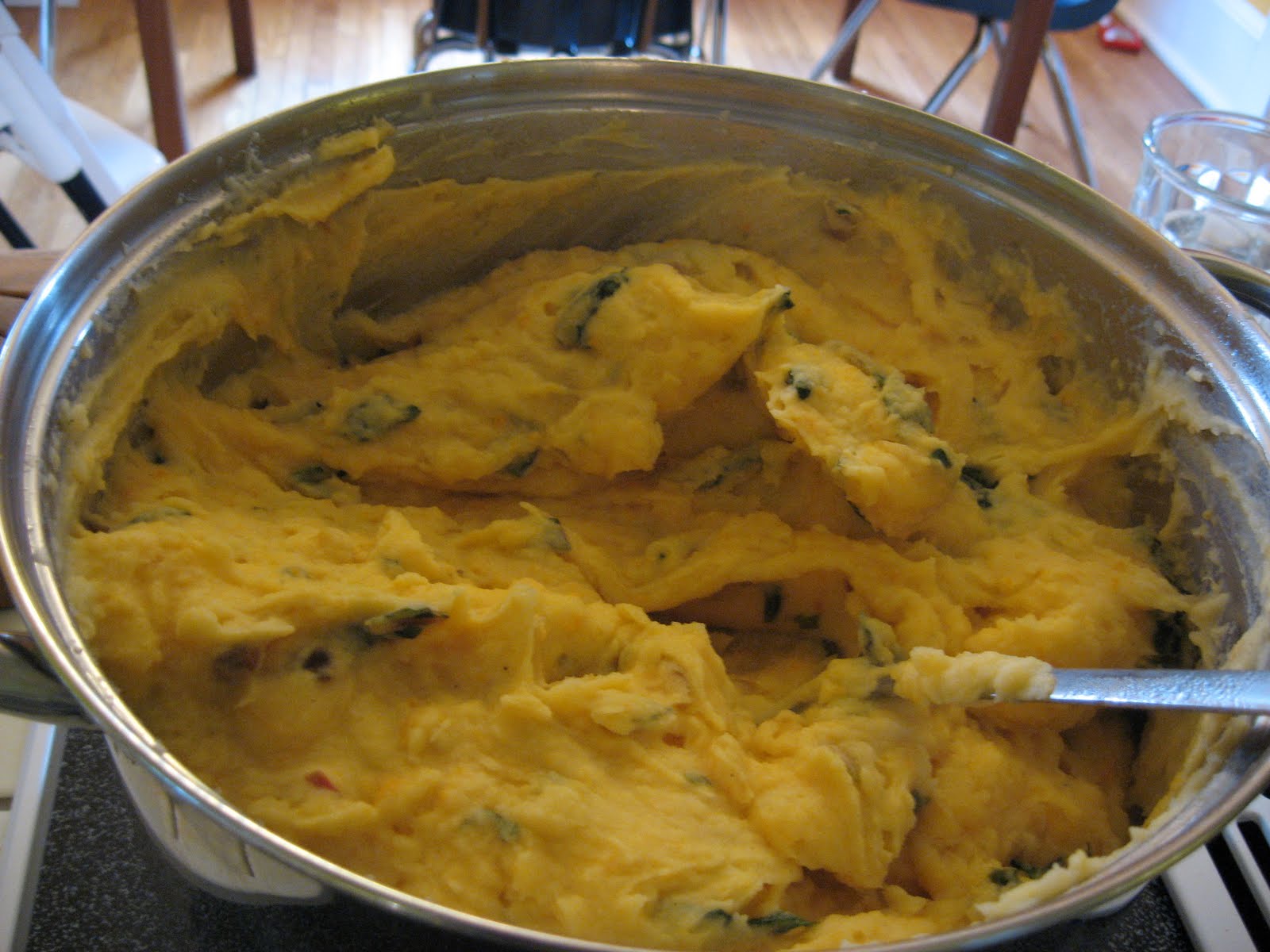
Orange and Green Mashed Potatoes
Roasted Asparagus with Thyme, Blood Oranges and Pine Nuts
Salad of Kiwi, Strawberry and Pineapple
Buttery Flaky Rolls with butter and homemade marionberry jam
Rhubarb Cupcakes with whipped cream, diced roasted hazelnuts and crystallized ginger chips (repeat from last night)

I used rainbow chard for the greens in the mashed potatoes, chopping and adding the stems at the same time as the onions, and the leafy parts when the onions had softened and started to brown.


For the roast asparagus, clean a bunch of asparagus, snap off woody ends and snap remainder into two-inch pieces. Toast a handful of pine nuts in a dry skillet, and zest a blood orange, and set aside in a small bowl. Section three blood oranges, chop the leaves from a few sprigs of fresh thyme, and add them to the asparagus in a large bowl. Add salt, pepper, and a drizzle of olive oil, and toss to distribute evenly. Roast in a single layer in a parchment-lined pan at 475 degrees for 10-15 minutes (10 was perfect for me), then toss with reserved pine nuts and zest. I prepared the pan of asparagus and oranges and set it aside until I pulled the lamb out of the oven. Just be on the lookout for kitchen "helpers" who steal raw asparagus (hi Mom! She's actually a really great sous chef, but she does have a weakness for snitching, as you can see below).


The potatoes just before transferring to their serving bowl:


Simmering the lamb sauce to reduce it further:


My plate, just before digging in (lookit all the pretty colors!):

Saturday, March 31, 2007

Spring Dinner

It's spring, so the chinook are running in the Columbia. We've eaten it twice this week--Tuesday (joined by my parents, who are visiting) simply roasted with a little olive oil and fresh thyme, with a side of saffron orzo, spinach, basil, peas and pine nuts; tonight (joined by MWR) cooked en papillote with asparagus, scallion, lemon and dill with roast fingerling potatoes on the side (recipe adapted from Real Simple).


For each packet, tear a piece of parchment paper about 10 inches wide or so off the roll. Put on the parchment, just off center, a piece of salmon, some two-inch pieces of asparagus, and a good five-finger pinch of minced dill and scallions. Drizzle with EVOO, squirt with a quarter-lemon, sprinkle with salt and freshly ground pepper, and, starting at one side, twist the paper to make a tight packet around the food. Roast at 400 for 20 minutes and the above picture is what you get. Next time I'll do it for only 15 and see how it turns out. The potatoes were tossed with a little olive oil and roasted separately for about twice as long. Optimally I would have two ovens and be able to roast the potatoes at a higher temp for more browning/crisping.

For dessert, rhubarb cupcakes with whipped cream, chopped crystallized ginger and diced roasted hazelnuts. For the cake, I used a recipe from The Moosewood Book of Desserts, but I think any buttery cake would work fine. Put about 3/4 of the batter into the tin, sprinkle with diced rhubarb (being careful not to press it down, which will make it sink during baking), then top with the last bits of batter. You don't need to worry about spreading the batter to cover the rhubarb; the heat of the oven will do that job quite handily.

Saturday, March 10, 2007

Book Group Brunches

My book group met today for the first time in nearly a year. I started it five years ago last fall, but last year we got into a slump, or maybe just out of the habit, and I'd really desperately like to get back into the swing of things. Partly because having deadlines gets me to read more books (as opposed to reading magazines or watching TV, in both of which I am terribly behind at the moment), and partly because I LOVE having an excuse to put together a fancy-ish three-course brunch, using local and seasonal ingredients, of course, for an audience more appreciative than my children.

Today's book was Sometimes a Great Notion by Ken Kesey. We picked it because it was recently named "Best Oregon Book Ever" by Portland Monthly magazine, and also because it's one of the longest-residing denizens of my "to be read" shelf. Oh my goodness--why haven't I read this book sooner?!?!? I guess because it's on the hard side for a high school audience, and I didn't go to college in Oregon (I used my sister's copy, which she got for a class at a local community college). It is on the more demanding side in structure--he changes point of view very frequently, and jumps around in place and time, as various characters have flashbacks. But once you get the hang of it, get to know the characters, it becomes much easier to tell who "I" is at any given moment. This is definitely a book that lends itself to reading in large chunks, and not in bits and pieces. For sure the last 130 pages or so (it's 600+ pages in most printings, of which there have been many) should be read at once.

We were intrigued to discover that the book was made into a movie in 1971, starring Henry Fonda and Paul Newman. I'm not thrilled with this casting (of course I had my own mental pictures of the main characters), but I've reserved the movie at the library, and we'll screen it at a future date if I can figure out a good way to hook my VCR back up to my TV.

Today's menu was not my most, well, mostes', because each thing I served was a repeat from a previous meeting (ideally I don't like to repeat). And some items on the original menu were dropped when I opted to finish the book last night instead of doing more shopping/running around. For instance, I had wanted to start with bran muffins and frozen peaches (a tradition in my family), but my sil ended up not coming, and I didn't make time to go pick some peaches up from her (I've decided now that I'll freeze some myself this year). So we didn't have a real starter course, and I served the bran muffins alongside the main dish, quiche with fresh wild salmon, asparagus, and gruyère. For dessert I wanted something chocolate, but with this week's schedule (we returned from out of town Wednesday afternoon) I decided to scale back and serve a purchased Guinness Stout Cake (a very chocolatey affair, despite the name) from Marsee Baking.

The quiche I made from the Bittman, only using one-inch cubes of salmon, two-inch pieces of blanched asparagus, and about a cup of finely grated 15-month raw-milk gruyère instead of the onions in his basic recipe. The 6 eggs and 2 cups half and half called for in his recipe overflowed my deep-dish partially-blind-baked (12 minutes at 425) shell, so I think next time I'll try 1 1/2 C half and half. I think because I didn't cook the salmon first, the quiche took nearly twice as long to bake as it said in the recipe (30-40 minutes at 325), and the asparagus was slightly overcooked. If I do it this way again, I'll shorten the blanching time (today was 1 minute) considerably (like to 15 seconds). I love quiche, and it's another one of those things that are so much better when they're homemade. This morning I managed to make two pie shells and freeze one, so my next quiche will hopefully be not long in coming.

The bran muffins were an enormous hit--five of us downed 12 mini and 7 full-size muffins, slathered with butter (they actually can make a pretty good argument for being healthy before you do that). Here is the recipe:

2 C boiling water
5 t soda

Mix these together and let cool.

1 C butter, softened
2 C sugar
4 eggs
1 qt buttermilk
5 C flour
4 C All-Bran
2 C Bran Flakes
2 C dates, chopped

Cream butter and sugar, then add eggs one at a time, beating well after each addition. Then add other ingredients, in order (don't forget to add the soda water with the other wet ingredients). If you are mixing it in a Kitchenaid, you will need to transfer it to a larger bowl after adding the flour, and then fold in the cereal and dates. Once you have it all mixed together, you can keep it in the fridge for at least a couple of weeks. Just don't stir it before baking. Fill greased muffin cups (or cupcake papers) 1/2-2/3 full (I use appropriately-sized ice cream scoops), and bake at 375 for 25 minutes.


Our next book will be Atonement by Ian McEwan (another long-time resident of the to-be-read shelf), and we've picked a tentative meeting date of April 14. Here's to hoping we re-establish the habit!

Monday, January 29, 2007

All Hail the Bard of Caledonia

Saturday last, we hosted a Burns Supper. These are traditionally held as near as possible to his birthday on January 25, and are supposed to feature a menu of traditional Scottish fare, as well as songs, poems, and toasts. Our menu was mostly traditionalish, with some variance for the sake of convenience and some for the sake of American taste buds.

Menu and program:
Selection of Cheeses and sparkling beverages
Cock-a-Leekie Soup

Brief discourse on the life and times of Robert Burns
Address to a Haggis


"Haggis" warm reeking, wi' Bashed Neeps and Champit Tatties

Toast to the Lassies
Lassies' Response


Salad of Baby Spinach, Mache and Watercress with Shanagarry Cream Dressing

More songs and poems:
To a Mouse, on Turning Her Up in Her Nest with the Plough
A Red, Red Rose
Comin' Thro the Rye


Trifle with homemade Tayberry Jam and Fresh Local Kiwi

The cheeses were purchased at my favorite local cheese purveyor, Pastaworks (in City Market). I initially asked for Scottish cheeses, but they had none! In fact, they said, they only even knew of one. So I got an aged English cheddar (Borough Market), and then two other tried-and-true-though-not-Scottish favorites (Formaggio Crucolo and Fromager d'Affinois). It was a pretty white cheese layout, but at least there were one soft, one semi-soft, and one hard cheese.

The Cock-a Leekie soup was adapted from The Joy of Cooking. Here's how I made it:
5 large leeks
2 T butter
2 large boneless, skinless chicken breasts (about 1.5 lbs)
1 C frozen homemade concentrated chicken stock
whole black peppercorns
few sprigs fresh thyme
1/2 C heavy cream

Bring about 2 quarts of water to a boil in a 3.5 quart pot, add 10-12 black peppercorns, thyme and chicken and simmer until chicken is done (you could add more flavor-y stuff here, like carrot or celery or bay leaves, but I was lazy and didn't have any bay leaves anyway). Put chicken on a plate and cover with plastic wrap so it doesn't dry out, and let cool. Reserve cooking liquid. When chicken is cool, remove fat and other nasty bits, and shred with your fingers.

Cut root end (at widest part of "bulb") and green tops (where leaves turn all green and start to fan out) of leeks off. Cut remainder in half lengthwise and immerse in cool water. Separate the layers so you get all the grit out, then drain. Cut crosswise into 1/8-inch pieces. Heat dutch oven over medium-high heat until hot, then add butter. When foaming subsides, add leeks. Stir to coat with butter and start to soften, then reduce heat to low and cover. Cook, stirring occasionally, until leeks are thoroughly wilted and a lovely chartreuse. Add homemade chicken stock, about six cups of reserved poaching liquid, and shredded chicken, and bring to a simmer. Adjust seasonings, and, just before serving, remove from heat and stir in cream.

The "Haggis" was really a meatloaf in puff pastry:


2 sheets frozen puff pastry, thawed according to package instructions
1 lb ground pork
1 lb ground beef
1 lb ground veal
1 C steel-cut oats
2 eggs
1/2 t mace
1/2 t allspice
1/4 t cardamom
1/8 t ground cloves
salt and pepper
2 onions
leaves from several sprigs fresh thyme

Slice the onions thin and saute slowly in a little olive oil over low heat (separating rings) until caramelized (I usually add a little salt since it helps draw out the juices and move the process along). Preheat oven to 400. Mix all ingredients except pastry in a large bowl (I used my hands, or rather, one hand, since the thumb on the other hand was a mandoline casualty of onion slicing). Unfold sheets of puff pastry and roll on pastry cloth so they're about 16 inches wide (rolling only one direction and not turning dough). Arrange dough so long edges on one side overlap by about an inch, brush cold water in the overlap, and press to stick together. Put the meat on the dough and squish into a nice log, leaving space at the ends for the pastry to fold up. Then fold up ends and then long sides, brushing water on all the overlaps and pressing gently to stick together. Carefully roll "haggis" over and place on some kind of rack over some kind of sided pan (I used a broiler pan grill on a jelly-roll pan; the haggis hung just over the ends of the broiler pan). Cut a few slits in the top for steam to escape, cover loosely with foil, and roast in oven for 30 minutes. Remove foil and continue cooking until pastry is browned, and center of loaf has reached 160-165 degrees. Let rest for a while (30 minutes? We took a lot longer because of the Burns biographical sketch) before cutting and serving.

The Bashed Neeps recipe came from Traditional Irish Cooking by Darina Allen:
1 lb turnips
1/2 lb onions, sliced thin
1-2 T olive oil
2-4 T butter
salt and white pepper

Saute onions in olive oil over low heat until caramelized, 30-40 minutes (I did the onions for the "haggis" and the neeps at the same time, natch). Peel turnips (I used a paring knife--the peels are thick) and cut into 1.5-inch pieces. Cover with water, add salt, and boil until tender. Drain, mash with the butter, stir in the onions, adjust seasonings, and serve.

The "Champit Tatties" were prepared according to the custom of our house: "orange" mashed potatoes, with sauteed chopped onions and red kale stirred in at the end.
4-5 lbs russet potatoes (I started out with a 5-lb bag, but there were lots of rotten spots)
3 largish garnet "yams"
1 medium onion, chopped
1 bunch red kale, stems removed, roughly chopped (any green will work, just adjust cooking time as necessary)
1-2 T olive oil
1-2 t bacon grease (from another dinner--I keep the leftover grease in the freezer)
1/2 C unsalted butter
1 1/2 C half-and-half (give or take--just enough to reach the right consistency)

Peel the potatoes and "yams," cut into two-inch pieces (in half for most of the russets), cover or nearly so with water, salt appropriately, and boil until tender (when stabbing them with a fork meets no resistance). While they're cooking, saute onions and kale together in the bacon grease and olive oil over medium-low heat until onion is soft and starting to brown and kale is no longer crunchy, then set aside. When potatoes are done, drain, add butter, and mash to desired consistency (I variously use a masher, a hand mixer or a food mill, depending on mood). Add half and half to make them just a little soupier than you eventually want them to be, since they'll keep absorbing liquid as they sit. Stir in reserved onions and kale, adjust seasonings and serve.

The salad dressing also came from Darina Allen's book. The trifle recipe leaned heavily on The Dessert Bible by Christopher Kimball (though the cake I made following a recipe in Cook's Illustrated). I didn't significantly change these recipes, but I'd be happy to pass them along if you really want me to. Trifle is one of those things that's hard to do wrong, so long as you use delicious components. I made a chiffon cake and cut it into four layers, then made two big jam sandwiches. Then I cut the sandwiches into small fingers, and used those for the cake layer. Then sliced halved kiwis (I put a row around the side of the bowl for a scallop effect), then the richest most decadent pastry cream ever (a dozen egg yolks, a quart of half and half, a cup of sugar, and then a cup's-worth of stiffly whipped cream folded into the chilled custard). Divine.