Showing posts with label sea lion's choice. Show all posts

Monday, July 20, 2009

Northwest-Indian Fusion

Or at least my attempt. For our book group meeting to discuss White Tiger by Aravind Adiga, I chose an Indian-inflected menu. Oh, it was nothing like the women in Jhumpa Lahiri's The Namesake, slaving all morning to put on a lunch spread of many dishes. I made a Salmon Biryani, substituting skinless Columbia River Chinook filets for the chicken in the Chicken Biryani recipe, skipping the browning step. I'm pretty sure they don't have salmon in India (somebody please correct me if I'm wrong), but if they did they would put it in a biryani like this. The raita (yogurt sauce as it's called in the recipe) was divine as always. I served it with Curried Cauliflower:
Ginger-Curry Cauliflower
adapted from Real Simple magazine

1 head cauliflower, broken into bite-sized florets
2 T olive oil
1 T unsalted butter
2 t grated fresh ginger root
2 t curry powder
1 t turmeric
1/2 t kosher salt (recipe originally calls for 1/4 t, but it wasn't enough)
1/4 C fresh bread crumbs
1/4 C chicken broth (optional; I've made it both with and without and it turned out fine either way)
1 T fresh parsley, minced (optional; if I'd remembered to save any of the mint and cilantro from the other menu items I'd have used that instead)

Steam cauliflower until fork tender. Heat oil and butter in a large skillet over medium heat. Add ginger, curry powder, turmeric, and salt and cook for 1 minute, stirring frequently. Add bread crumbs and cook another minute. Add cauliflower (and broth, if using) and cook until any liquid is absorbed and cauliflower is well-coated. Remove from heat and toss with parsley or other herbs, if using.

We had a palate-cleansing simple salad of baby greens, dried cherries and hazelnuts in balsamic vinaigrette, then finished with mixed berries (raspberries, boysenberries, marionberries and blueberries, purchased at the farmers' market that morning) over vanilla ice cream. Yum!

Saturday, April 25, 2009

Salmon-Asparagus Salad

I've made something similar to this in the past, but somehow never posted about it. I was in Utah this weekend and needed to do something with a filet of Costco salmon. Here's my solution, which also uses fresh in-season asparagus. In late summer and fall, when asparagus isn't so plentiful, it tastes great with green beans.


Salmon-Asparagus Salad
loosely inspired by The Barefoot Contessa Cookbook

1 filet (approx 2.5 lb) salmon
1 large bunch (2 lb? How big are the packages at Costco?) asparagus, ends snapped off and snapped into two-inch pieces

Spray salmon with olive oil and sprinkle with salt and pepper and bake at 400 degrees until just firm and opaque throughout. Let cool to room temperature and then refrigerate. Blanch asparagus pieces in boiling water for 30-90 seconds, depending on thickness of spears. Let cool and refrigerate also.

juice of one lemon
twice as much olive oil as lemon juice
1 pkg fresh dill, leaves stripped and minced (about 3-4 T)
3 T capers, minced
2 ribs celery, diced fine
1/2 red onion, chopped fine
1/2 or more English cucumber, cut into quarter-rounds
salt and freshly ground black pepper to taste

Mix lemon juice, olive oil, dill and capers with some salt and pepper, then stir in remaining ingredients and reserved salmon and asparagus. Adjust seasonings and serve.

Saturday, January 24, 2009

Life Without Corn

Our book group book this time around was The Omnivore's Dilemma by Michael Pollan. Inspired by the first section of the book, I thought I should try to avoid corn by-products in today's menu. It really wasn't all that hard--just avoid processed foods and non-organic meat. It's a good thing no one in attendance had nut allergies, since three different nuts were featured in three dishes today.

Hazelnut-Crusted Wild Alaskan True Cod with Cranberry Jelly
Nutted Wild Rice with Blood Oranges
Roasted Green Beans

Wintertime Chocolate-Caramel Tart
Tillamook Vanilla Bean Ice Cream

The fish was easy. I mixed some ground hazelnuts with about the same amount of bread crumbs, stirred in a little olive oil and salt and pepper, and spread it on the fish.


The green beans were also a cinch. The beans I found were a bit on the less-photogenic side, slightly shriveled and not the slim and lovely ones I love to eat, blanched, in late summer. Cook's Illustrated a couple of years back had talked about roasting as an option for this caliber of bean, and it is genius. Just snap off stem ends and spread on a foil-lined pan (for both the fish and the beans I used the bottom of a broiler pan, since they are less likely than my cookie sheet to warp in the oven), drizzle with a little olive oil and sprinkle with a little salt and pepper, and toss to coat.


Both the fish and the beans were set to cook at 450, so I was able to do them together, putting the fish in when the beans were ready for a stir after 10 minutes. The beans needed another 10 minutes to get spotty brown, and the fish a few minutes longer than that to get firm and just flaky. Delicious. I thought as I was putting it on the table that the fish could use some kind of sauce, so pulled out a jar of homemade cranberry jelly (from local cranberries, of course).

The salad is one I've been wanting to fix for book group for several years, since Grandpa Artsy-Fartsy fixed it on a visit. Perfect for citrus season. I made it pretty much straight, except with fewer raisins, I used blood oranges instead of navels, and I added the segments from about a half-dozen blood oranges (this last addition seemed like kind of a "duh" to me--how could you make a salad with an orange-juice-based dressing and not put any actual oranges in it?).

The dressing:


The segmented oranges (you slice off the peels with a serrated knife, then carefully cut alongside the membranes to release the good stuff):


The last bit (not a great photo, and in any case it tastes better than it looks):


The tart appeared in the paper last month. Nuts, caramel, chocolate, what else do you need? The only change I made was to use chocolate graham crackers instead of chocolate wafers for the crust. I think the wafers would have worked better.

The mixed-together crust:


Pressing the crust mix into the tart pan. I think I read the tip to use a stainless measuring cup in Cook's Illustrated. It really does an amazing job of preventing that blobby thick crust corner you can get if you use your fingers to press it into the pan.


The sugar and water, ready to make into caramel. The recipe says to stir it until the sugar is dissolved, but doesn't say to then stop stirring. But you should, because otherwise . . .


this happens. It ended up okay in the long run, but it would have been better had I not continued to stir.


The cream to stir into the melted sugar:
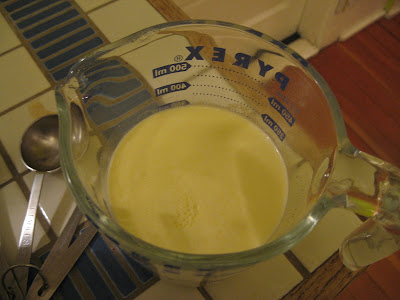

The egg and vanilla to fold into the cool-ish caramel:


The baked almond caramel in the chocolate tart shell:


Now, the recipe calls for heating cream on the stovetop and adding it to chopped chocolate to make the ganache. I always make my ganache in the microwave, with the cream and chocolate in the same bowl. Start out with a minute on high, then stir well, and zap in additional 30-second increments, stirring well in between (I think it did maybe two extra 30-second periods). It will start out looking like this:


Proceed to this:


And finally end up like this, smooth and glossy:


Here's what the cooked tart looked like. I thought it was pretty good, and the other members of the group RAVED. I thought the crust could have been better (I'll use the wafers next time), and the nuts didn't retain their roasted crunch. I don't know if that was because of how I stored it, or just a quirk of the recipe.


Now, I had originally planned to make homemade vanilla ice cream (I finally got around to making the custard today, with the Wizard's help), which would have been corn-free, but the Tillamook did unfortunately feature HFCS among its ingredients. There were also corn products in the graham crackers I used for the tart crust, and possibly in the bread crumbs I put on the fish (they weren't made from home-made bread). I guess technically the eggs probably also came from corn, but you can't really count that because chickens (unlike cows) are made to eat corn.

Monday, May 5, 2008

Springer

Yes, it's truly spring. The farmers' market is starting to have some real food available (not just greens and other winter carryovers), and the chinook are running in the Columbia. Saturday's dinner was almost entirely fresh from the farmers' market, and fixed in just about the simplest way possible: baked salmon fillets, blanched asparagus, and boiled baby potatoes. I drained the potatoes and tossed some butter in the pot to melt, then realized that I had frozen cubes of chopped herbs in EVOO left from last summer. I tossed one of those in, too, and oh, the deliciousness.


The salmon was sold unfilleted, as "roasts," i.e. the whole fish, gutted and then chopped rather unceremoniously into 2-3 lb chunks. So yay--my first experience with doing the filleting myself. I learned as I went, and the second half was rather neater than the first. It was a tad more than we needed for one meal, so I saved all the little bits, and last night adapted the Chowdah for the salmon, substituting it for the chicken, adding additional veggies (cauliflower and broccoli), using 2% instead of whole milk, and using a couple more of those frozen herb cubes (which probably contain a mixture of parsley, cilantro, basil and dill, though I can't be 100% sure) instead of freshly-chopped parsley. Besides cheddar, we also had a little locally-made dill havarti. Could not have been easier, or more delicious.


I didn't have bread to go with (need to mix up another batch of Simple Crusty Bread), so I made up a spare box of Jiffy corn muffins (bargain of the century at 69 cents a box). Perfect.

Monday, March 10, 2008

Never again! Stop me if you sense me heading that direction.

About every three years, I see an intriguing recipe and decide that it would be a good idea to pan-sear salmon. And then somehow I magically forget how messy it is, and how the smell lingers in the downdraft vent until it gets thoroughly degreased. I guess it's like childbirth that way, except that the end product (NPI) is more temporal.

So Saturday night I decided to try a pan-seared salmon recipe from Cook's Country (to which I subscribed for a year, until I decided my recipe inflow was insanely excessive; this recipe came from a recent free issue they sent me trying to get me to resubscribe). The thing was, I was in a hurry to get the salmon into the pan because the oil was smoking, and I splattered grease on my face and right hand. I don't recommend doing this. I managed to finish preparing dinner while spending as much time as possible holding my hand under cool running water (it blistered anyway) and pressing a cool wet dishtowel to my face (it didn't blister, but I am looking considerably more blotchy than is usual). I hope you'll understand why I didn't manage to take any pictures. I'm just glad I was wearing glasses, as a couple of big blobs hit smack in the middle of the lenses. I shudder to think.

Anyway, the pan-seared salmon was good, as usual, but not really worth the extra trouble, as usual, not to mention the injuries. The glaze was pretty tasty, though, and I'll probably make it to go with salmon prepared another way.
Balsamic Glaze

1/4 C balsamic vinegar
1/4 C orange juice (I used the juice of half of a large navel)
2 T honey
1 sprig fresh rosemary
2 T cold unsalted butter, cut into cubes
salt and pepper to taste

Mix vinegar, juice and honey to dissolve honey, then put in a small skillet with rosemary. Simmer and reduce until it's syrupy and only a couple of tablespoons remain. Turn off heat, leaving pan on warm burner, and stir in butter. Season with salt and pepper and serve over salmon.

Saturday, March 31, 2007

Spring Dinner

It's spring, so the chinook are running in the Columbia. We've eaten it twice this week--Tuesday (joined by my parents, who are visiting) simply roasted with a little olive oil and fresh thyme, with a side of saffron orzo, spinach, basil, peas and pine nuts; tonight (joined by MWR) cooked en papillote with asparagus, scallion, lemon and dill with roast fingerling potatoes on the side (recipe adapted from Real Simple).


For each packet, tear a piece of parchment paper about 10 inches wide or so off the roll. Put on the parchment, just off center, a piece of salmon, some two-inch pieces of asparagus, and a good five-finger pinch of minced dill and scallions. Drizzle with EVOO, squirt with a quarter-lemon, sprinkle with salt and freshly ground pepper, and, starting at one side, twist the paper to make a tight packet around the food. Roast at 400 for 20 minutes and the above picture is what you get. Next time I'll do it for only 15 and see how it turns out. The potatoes were tossed with a little olive oil and roasted separately for about twice as long. Optimally I would have two ovens and be able to roast the potatoes at a higher temp for more browning/crisping.

For dessert, rhubarb cupcakes with whipped cream, chopped crystallized ginger and diced roasted hazelnuts. For the cake, I used a recipe from The Moosewood Book of Desserts, but I think any buttery cake would work fine. Put about 3/4 of the batter into the tin, sprinkle with diced rhubarb (being careful not to press it down, which will make it sink during baking), then top with the last bits of batter. You don't need to worry about spreading the batter to cover the rhubarb; the heat of the oven will do that job quite handily.